
Strain Gauge Systems for Structural Testing

How to Choose a Strain Gauge Measurement System for Structural Testing
Choosing the right strain gauge measurement system is not only about finding a device that can read strain.
For structural testing, the real question is:
Can the system capture accurate, stable, synchronized strain data under the actual load, environment, duration, and scale of the test?
Strain measurement is used to understand how structures respond to force, pressure, vibration, temperature, fatigue, and real operating loads. Engineers rely on this data to validate designs, improve safety, compare simulation results, identify stress concentration areas, and support product qualification.
The right system should match the test object, strain gauge type, bridge configuration, channel count, sampling rate, synchronization needs, environmental conditions, and analysis workflow.
This guide explains how to choose a strain gauge measurement system for structural testing, especially for applications such as aircraft structures, UAVs, landing gear, wind tunnels, pressure cabins, bridges, pipelines, machinery, automotive components, and large-scale engineering structures.
What Is a Strain Gauge Measurement System?
A strain gauge measurement system captures small changes in electrical resistance from strain gauges bonded to a test object. These resistance changes are converted into strain values, usually expressed in microstrain.
In structural testing, the system usually includes:
Strain gauges
Bridge completion circuits
Excitation source
Signal conditioning
Synchronization system
Test software
Data recording and analysis tools
Optional sensors such as displacement sensors, load cells, force sensors, pressure sensors, temperature sensors, and accelerometers
A complete strain measurement system should do more than collect signals. It should help engineers monitor structural behavior clearly, reliably, and in real time.
For large structural tests, this may include hundreds or thousands of channels. For smaller R&D tests, it may include only a few channels, but still require high accuracy, clean signal quality, and stable measurement.
Why Strain Measurement Matters in Structural Testing
Structural strain testing helps engineers understand how a structure behaves under real or simulated load.
It can answer questions such as:
Where does the structure experience the highest stress?
Are the measured strain values within the expected design limits?
How does the structure deform under static or cyclic loading?
Does the physical test match the simulation model?
Which areas are at risk of fatigue or overload?
Does the structure remain stable during long-duration testing?
Are joints, frames, panels, brackets, or attachment points behaving as expected?
This is especially important in industries where structural reliability directly affects safety and performance, including aerospace, automotive, civil engineering, transportation, energy, machinery, and research.
1. Start with the Structural Test Objective
Before choosing a strain gauge measurement system, define the purpose of the test.
Different structural tests require different measurement setups.
Common structural strain testing applications
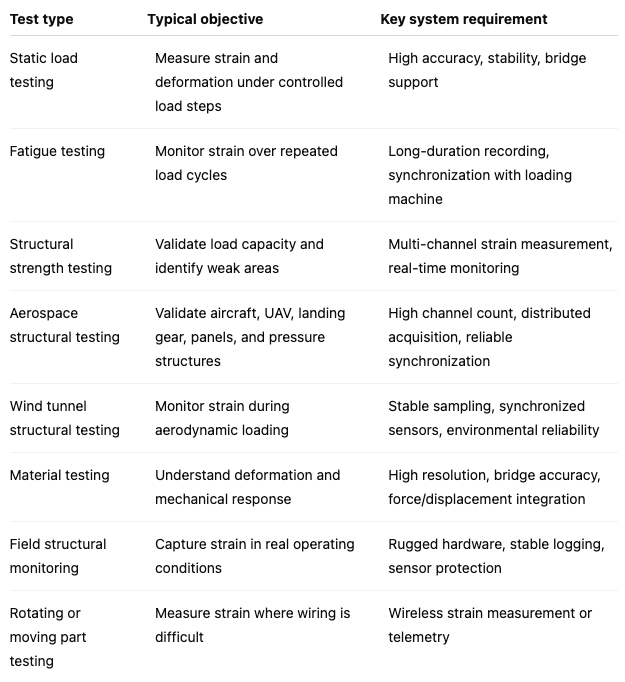
A strain measurement system should be selected based on what the engineer needs to prove, not only based on the number of input channels.
See: Wind Tunnel Structural Strain Testing application
See: Aircraft Landing Gear Static Load Test application
2. Define the Required Channel Count
Channel count is one of the first things engineers consider, but it should not be treated as a simple number.
The required number of channels depends on:
Number of strain gauges
Number of measurement locations
Number of bridge circuits
Whether the test includes displacement, load, pressure, acceleration, or temperature
Whether the structure is tested as one component or several zones
Whether the test may expand later
Whether redundancy is required for critical points
Whether multiple systems must work together
A small component test may need 8, 16, or 32 channels.
A landing gear test may need hundreds of channels.
A full-scale aircraft structural test may need thousands or tens of thousands of channels.
For large structures, engineers should also consider whether the system can be divided into zones, such as wings, fuselage, joints, frames, supports, or test rigs. A modular architecture can make the system easier to expand, troubleshoot, and manage.
What to check
Before selecting the system, ask:
How many strain channels are needed now?
How many may be needed later?
Will the system also measure force, pressure, displacement, acceleration, or temperature?
Can the DAQ system expand without replacing the whole platform?
Can multiple chassis or subsystems be synchronized?
Can channels be organized clearly in software?
For large-scale structural testing, channel management becomes just as important as channel quantity.
See: 1500-Channel Integrated DAQ System application
See: Full-Scale Aircraft Structural Testing with SE-98 System application
See: SE-98 Dynamic Stress-Strain Testing and Analysis System
3. Choose the Right Bridge Configuration
Strain gauges are usually connected using Wheatstone bridge circuits. The measurement system must support the correct bridge configuration for the application.
Common configurations include:
Quarter bridge
Half bridge
Full bridge
Three-wire quarter bridge
Bridge-based force or load sensors
Each configuration has different advantages depending on the test requirement.
Quarter bridge
A quarter bridge uses one active strain gauge. It is commonly used when many points need to be measured and the structure allows individual gauge installation.
It is practical for structural mapping, but it requires good compensation and stable wiring.
Half bridge
A half bridge uses two active or partially active gauge elements. It can improve temperature compensation and sensitivity depending on the arrangement.
It is useful for bending, axial strain, and improved measurement stability.
Full bridge
A full bridge uses four active elements. It can provide higher sensitivity and better compensation when the measurement geometry supports it.
It is often used in load cells, force sensors, torque sensors, and more controlled structural measurement applications.
Three-wire quarter bridge
A three-wire quarter bridge helps reduce the effect of lead wire resistance, which is useful when gauges are installed far from the measurement system.
This can be important in large structures, aircraft tests, bridge testing, and distributed strain measurement.
What to check
Before choosing the system, confirm:
Does it support quarter, half, and full bridge?
Does it support three-wire quarter bridge?
Does it include bridge completion?
Does it provide stable bridge excitation?
Can bridge settings be configured in software?
Can the system compensate for wire resistance?
Can it support different gauge resistances such as 120Ω or 350Ω?
Can it handle both static and dynamic strain measurement?
A strain gauge measurement system without proper bridge support can limit the test before it even begins.
See: DE-944 Dynamic Signal Test and Analysis System
See: SE-98 Dynamic Stress-Strain Testing and Analysis System
4. Check Excitation, Stability, and Resolution
Strain signals are small. That means the measurement system must provide clean excitation and stable signal conditioning.
Poor excitation stability, noise, drift, or low resolution can make the test results unreliable.
Important parameters include:
Bridge excitation voltage
Input voltage range
Microstrain range
Measurement resolution
Zero drift
Long-term stability
Noise level
Channel-to-channel isolation
Self-balancing capability
Calibration and self-checking functions
For structural testing, stability is especially important during long load steps, fatigue cycles, pressure tests, or thermal conditions.
A system may look suitable on paper, but if the signal drifts during a long test, engineers may struggle to separate real structural behavior from measurement error.
What to check
Ask the supplier:
What excitation voltage options are available?
Is bridge completion built in?
What is the strain range?
What is the microstrain resolution?
How stable is the system during long-duration tests?
Does it support self-balancing?
Does it support on-site channel checking or calibration?
How does the system manage noise and grounding?
This is especially important for aircraft structural testing, fatigue testing, pressure vessel testing, and civil engineering monitoring where the accuracy of small strain changes matters.

5. Match Sampling Rate to the Test Type
Not every strain test requires a high sampling rate.
Static load tests may need stable low-speed measurement at each load step. Dynamic strain tests, impact tests, vibration-related strain tests, and high-speed structural events need faster acquisition.
The sampling rate should match the event being measured.
Static strain testing
For static load testing, engineers need stable readings during each load step. The focus is often accuracy, low drift, repeatability, and clear comparison between load and strain.
Examples include:
Aircraft fuselage static load testing
Wing structural testing
Landing gear load testing
Material compression testing
Pressure vessel testing
Bridge and civil structure load monitoring
Dynamic strain testing
For dynamic strain testing, engineers need to capture changing strain signals over time. The system must sample fast enough to capture the event without missing peaks or phase relationships.
Examples include:
Vibration-induced strain
Impact response
Rotating component strain
Machinery dynamic load testing
Fatigue testing
Aero-engine structural testing
Transportation and vehicle tests
What to check
Ask:
Is the test static, quasi-static, dynamic, or transient?
What is the maximum frequency of interest?
Does every channel sample at the required rate?
Is the sampling simultaneous across channels?
Are anti-aliasing filters available?
Can the system record continuously for the required duration?
Can the sampling rate be synchronized with the loading machine?
Choosing the wrong sampling rate can cause missed peaks, poor fatigue analysis, or inaccurate dynamic response interpretation.
See: DE-924U High-Speed Data Acquisition System
See: DE-944 Dynamic Signal Test and Analysis System
See: Aero-Engine Turbine Shaft and Blade Stress Testing
6. Make Synchronization a Priority
In structural testing, multiple signals often need to be compared together.
A strain gauge on one part of the structure may need to be compared with:
Another strain gauge
Load cell data
Displacement sensor data
Hydraulic actuator position
Pressure data
Acceleration data
Temperature data
Vibration data
Test machine data
If the timing is not aligned, engineers may not be able to understand how the structure responded to the load.
Synchronization is especially important for:
Fatigue testing
Multi-zone aircraft testing
Wind tunnel structural testing
Dynamic strain testing
Structural vibration testing
High-channel-count DAQ systems
Tests involving load machines or hydraulic actuators
Multi-parameter measurement
What to check
Before selecting a strain gauge DAQ system, confirm:
Are all channels sampled synchronously?
Can multiple chassis or subsystems be synchronized?
Can the system synchronize with loading machines?
Can it integrate load, displacement, pressure, vibration, and strain data?
How is timing handled across distributed modules?
Is the software able to display and record all data in one timeline?
For large-scale structural tests, synchronization is not an optional feature. It is what allows engineers to interpret the test as one complete event.
See: Fatigue Loading Test on Aircraft Pressure Cabin
See: Wind Tunnel Structural Strain Testing
7. Consider Environmental and Installation Conditions
Structural tests do not always happen in ideal laboratory conditions.
Some tests are performed in aircraft hangars, wind tunnels, outdoor structures, vehicle platforms, civil engineering sites, production environments, test cells, or harsh field conditions.
Environmental and installation factors can affect measurement quality.
Important factors include:
Temperature changes
Humidity
Vibration
Electromagnetic interference
Cable length
Ground loops
Installation space
Connector reliability
Sensor protection
Long-duration operation
Field power conditions
Data backup requirements
If the test environment is harsh, rugged data acquisition or distributed acquisition may be needed.
If the structure is large, cable length and wire resistance become important.
If the test environment has high electromagnetic noise, shielding, grounding, isolation, or fiber optic sensing may be required.
What to check
Ask:
Where will the test take place?
How long will the system need to record?
Are the measurement points far from the DAQ hardware?
Will the system face shock, vibration, heat, humidity, or EMI?
Is rugged hardware required?
Are fiber optic strain sensors needed for EMI-sensitive environments?
Is backup storage required for critical testing?
Can engineers access the measurement points during the test?
The measurement environment should influence the system architecture from the beginning.
See also: Fiber Optic Strain Sensors
See: Mengzhou Abort Flight Test
See: Civil Engineering Applications

8. Decide Between Centralized, Distributed, and Wireless Strain Measurement
A strain gauge measurement system can be designed in different architectures.
The right choice depends on the structure size, measurement point layout, cabling difficulty, movement, and test environment.
Centralized strain measurement
A centralized system is useful when many sensor cables can be routed back to one test station or cabinet.
It is suitable for:
Laboratory structural testing
Static load testing
Fatigue testing
Aircraft component testing
Material testing rigs
Controlled test environments
Advantages:
Easier central control
High channel density
Suitable for cabinet installation
Good for large fixed test systems
Distributed strain measurement
A distributed system is useful when measurement points are spread across a large structure.
It is suitable for:
Aircraft structures
Bridges
Wind tunnel structures
Large machinery
Civil structures
Multi-zone structural testing
Advantages:
Reduces long cable runs
Places acquisition closer to sensors
Easier expansion by zones
Better system organization
Wireless strain measurement
Wireless strain measurement is useful when cables are difficult, unsafe, or impossible.
It is suitable for:
Rotating shafts
Moving components
Vehicle testing
Field testing
Hard-to-wire structures
Temporary test setups
Large mechanical structures
Advantages:
Reduces cable complexity
Supports moving or rotating parts
Improves installation flexibility
Helps capture data from locations where cables cannot go
See: WW-844D Wireless Dynamic Strain Test and Analysis System
See: Engine Strain and Torque Wireless Testing
See: Wireless Data Recording System
9. Do Not Ignore Software and Data Workflow
A strain gauge measurement system is only useful if engineers can configure, monitor, record, analyze, and export the data efficiently.
Good software matters because structural tests can include many channels, long test durations, and multiple physical quantities.
The software should support:
Channel configuration
Bridge setup
Sensor information management
Real-time monitoring
Load-strain curve visualization
Alarm or threshold settings
Long-duration data recording
Multi-channel comparison
Synchronous display of multiple signals
Data export
Reporting
Calibration and self-check workflows
Measurement point naming and grouping
For high-channel-count tests, clear channel management is critical. Engineers should be able to identify measurement points quickly, group them by structure area, and review data without confusion.
The system should also make it easier to compare test results with simulation or design expectations.
10. Check Compatibility with Other Sensors
Structural testing rarely uses strain gauges alone.
A complete test may include:
Load cells
Force sensors
Pressure sensors
Displacement sensors
LVDTs
Laser displacement sensors
Accelerometers
Temperature sensors
Torque sensors
Speed sensors
Fiber optic strain sensors
The measurement system should support these signals directly or integrate with other DAQ modules.
This is important because structural behavior is easier to understand when strain data is connected to the load, displacement, vibration, pressure, and temperature data from the same test.
For example:
In landing gear testing, strain data may need to be compared with load and displacement.
In wind tunnel testing, strain may need to be compared with aerodynamic conditions.
In fatigue testing, strain must be synchronized with cyclic loading.
In pressure vessel testing, strain must be connected to pressure levels.
In rotating shaft testing, strain must be converted into torque.
A good system helps engineers see the complete measurement picture.
See also: Tension & Compression Force Sensors
See also: Pin Force Sensor
See also: Sensors
See: Aero-Engine Casing Hydrostatic Pressure Test
11. Plan for Calibration, Self-Check, and Test Reliability
Structural testing can be expensive and difficult to repeat. That means engineers need confidence before the test begins.
A strain gauge measurement system should help confirm that channels are working correctly before data collection starts.
Useful functions include:
Channel self-check
Bridge balance
Wire resistance correction
Calibration support
Sensor identification
Measurement point management
Fault detection
Real-time signal checking
Data backup
Stable long-duration recording
This is especially important for critical tests such as full-scale aircraft structural tests, fatigue loading, pressure testing, and field structural monitoring.
If one channel fails or drifts during a critical test, the team may lose data from an important location. For high-value test programs, system reliability is not just a convenience. It protects the value of the test.
12. Match the System to the Industry Application
The best strain gauge measurement system depends on the application.
Aerospace structural testing
Aerospace testing often requires high accuracy, multi-channel synchronization, stable long-duration measurement, and scalable architecture.
Typical applications include:
Aircraft full-scale static testing
Aircraft fatigue testing
UAV structural validation
Landing gear load testing
Pressure cabin testing
Aero-engine casing testing
Wind tunnel structural strain testing
Spacecraft landing and impact testing
See: UAV Structural Strain Testing with SE-98 System
See: Spaceship Landing and Water Impact Test
Automotive structural testing
Automotive testing may involve strain, vibration, force, displacement, and dynamic response measurement across the body, frame, suspension, engine mount, battery pack, or powertrain components.
Civil engineering and infrastructure
Civil engineering applications may require long-term or large-scale strain monitoring of bridges, pipelines, towers, buildings, buried piers, or structural connections.
See: Hong Kong-Zhuhai-Macao Bridge Buried Pier Installation
Machinery and industrial testing
Machinery applications may involve strain measurement during dynamic operation, sudden stops, pressure loading, structural fatigue, and safety validation.
See: Elevator Dynamic Performance Test Using DE-944 System
Research and education
Universities and laboratories often need flexible systems that can support strain, vibration, displacement, force, and temperature measurement across different test programs.
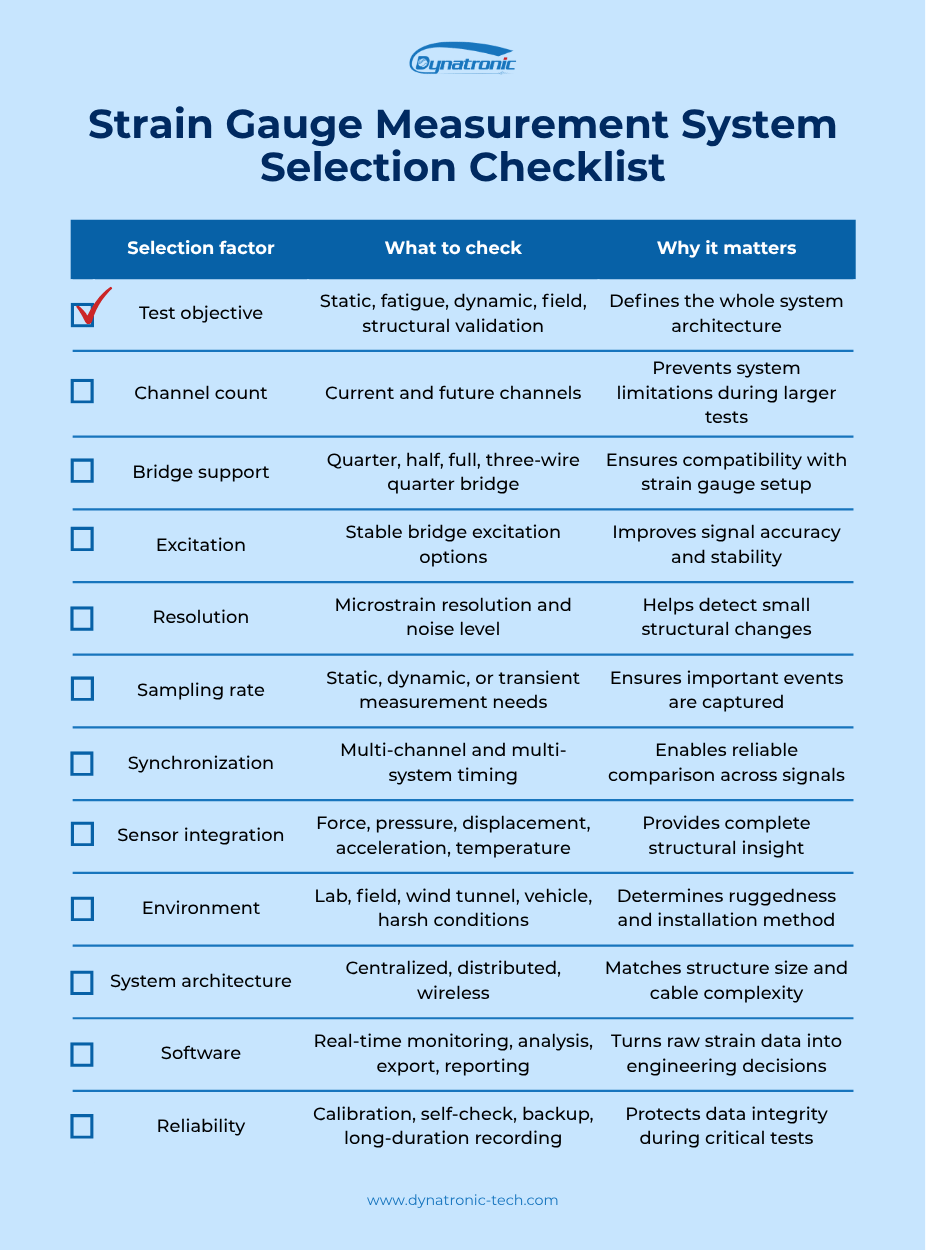
Strain Gauge Measurement System Selection Checklist
Use this checklist before choosing a system.
Recommended Dynatronic Solutions for Strain Gauge Measurement
Dynatronic provides several measurement systems for structural strain testing, depending on the application scale and test environment.
SE-98 Dynamic Stress-Strain Testing and Analysis System

The SE-98 is suitable for large-scale structural testing where engineers need synchronized, multi-channel stress-strain measurement.
Best suited for:
Full-scale aircraft structural testing
Static and fatigue testing
Large mechanical structures
Multi-zone test systems
Centralized cabinet-based test setups
High-channel-count strain measurement
Structural integrity evaluation
DE-944 Dynamic Signal Test and Analysis System
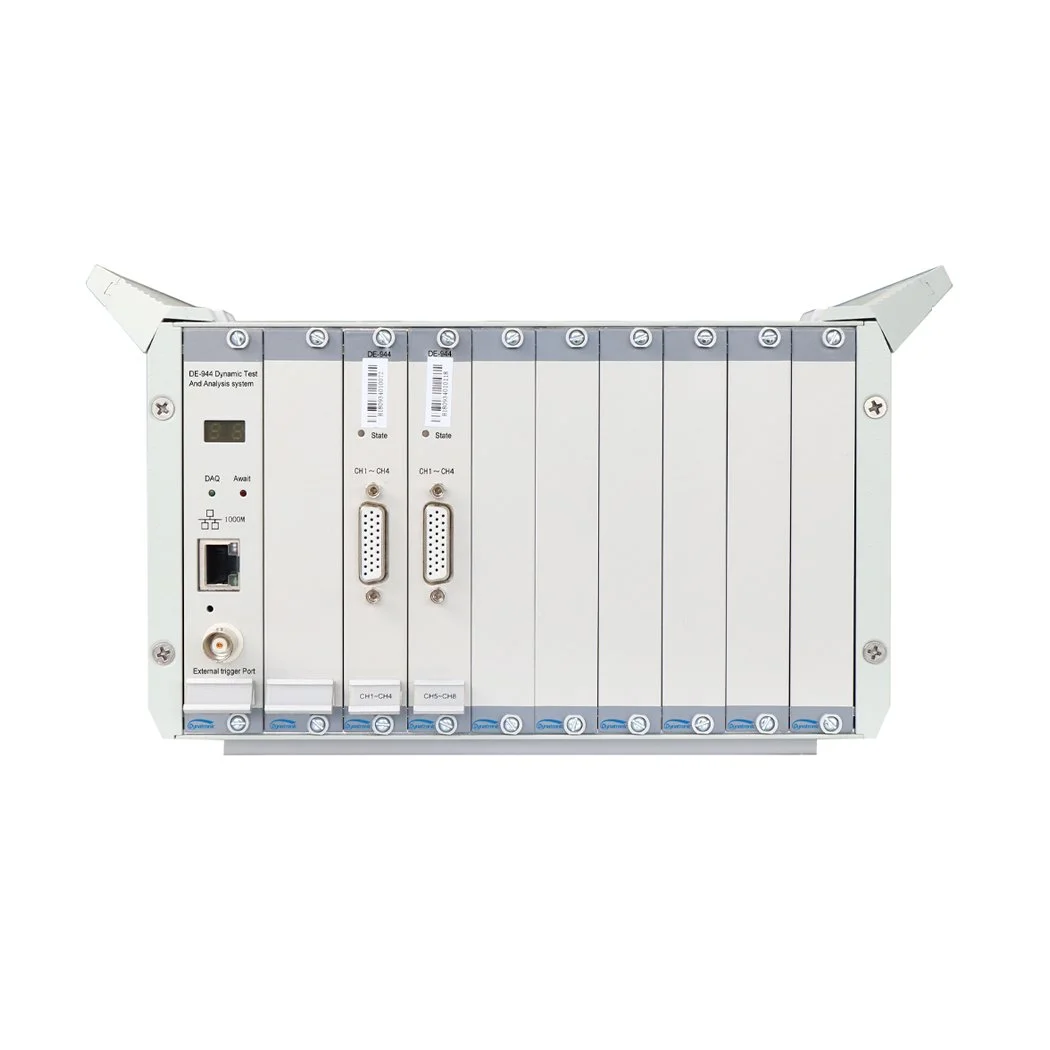
The DE-944 is suitable when engineers need dynamic signal acquisition, strain measurement, vibration measurement, IEPE sensor support, bridge completion, excitation, filtering, and high-speed DAQ in one system.
Best suited for:
Dynamic strain testing
Structural vibration and strain testing
Aero-engine testing
Machinery testing
Elevator performance testing
Pressure and structural validation
Multi-parameter DAQ workflows
DE-924U High-Speed Data Acquisition System

The DE-924U is suitable for high-speed dynamic testing where fast signal capture and real-time processing are required.
Best suited for:
Dynamic strain and vibration testing
Aerospace and automotive component testing
High-speed transient measurement
Multi-parameter engineering tests
WW-844D Wireless Dynamic Strain Test and Analysis System
The WW-844D is suitable for wireless strain measurement applications where cables are difficult, especially in large mechanical structures or moving components.
Best suited for:
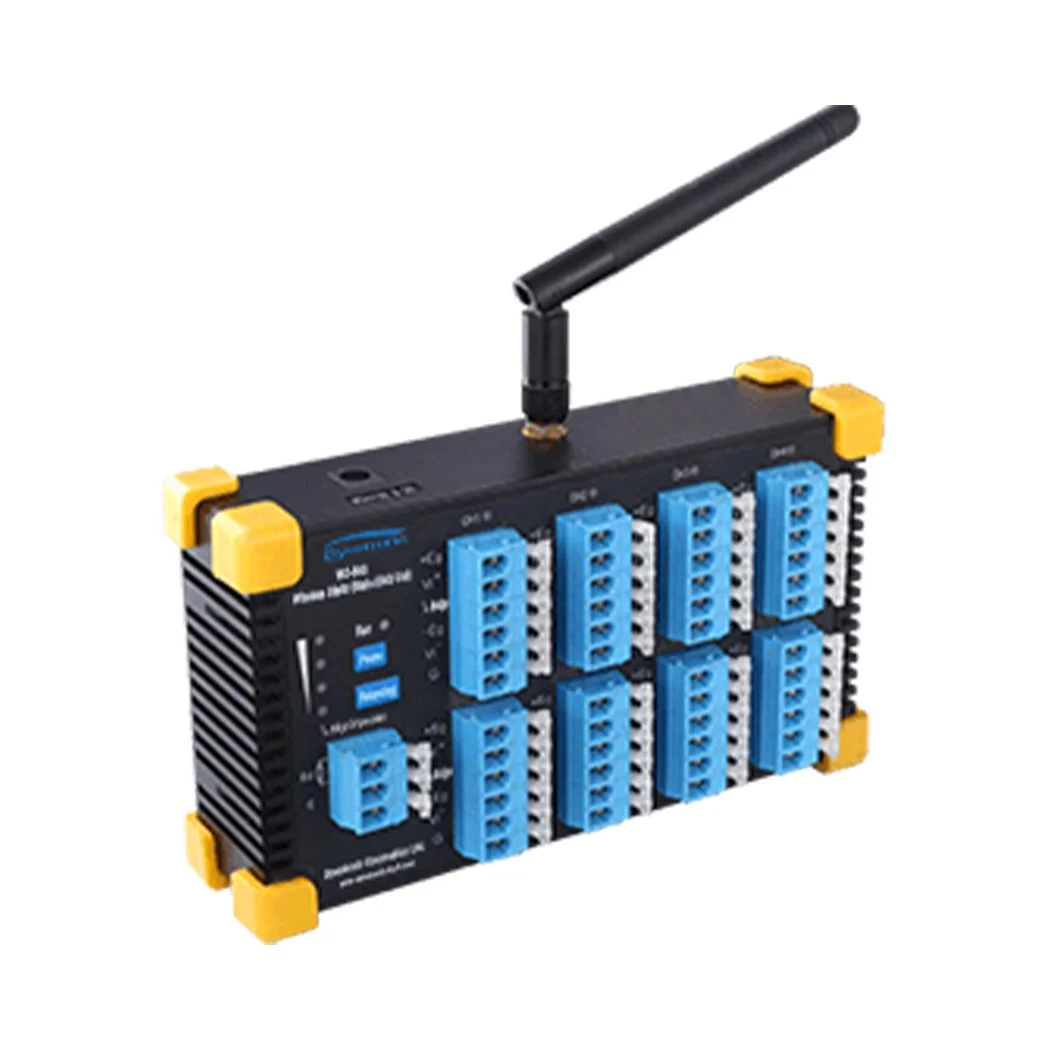
Wireless strain measurement
Rotating or moving components
Field testing
Large mechanical structures
Hard-to-wire measurement locations
Strength and life evaluation testing
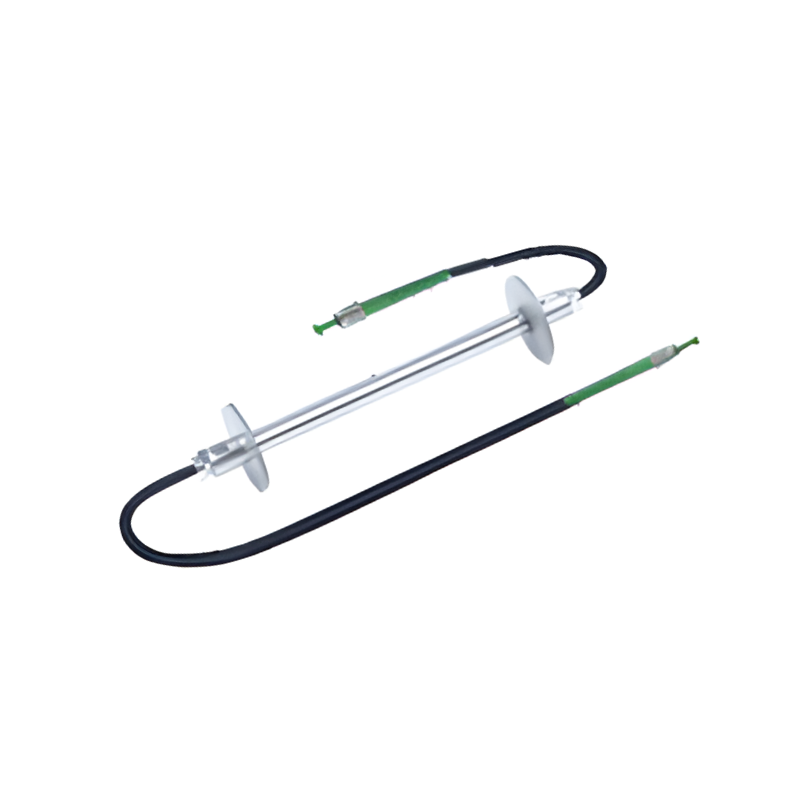
Fiber Optic Strain Sensors
Fiber optic strain sensors are useful when traditional electrical strain measurement may be affected by electromagnetic interference, radio-frequency interference, or ground loop issues.
Best suited for:
EMI-sensitive environments
Long-distance structural monitoring
Civil engineering structures
Energy and infrastructure applications
Harsh or electrically noisy test environments
Common Mistakes When Choosing a Strain Gauge Measurement System
Mistake 1: Choosing only by channel count
A high channel count is useful, but it is not enough. Engineers also need synchronization, bridge support, excitation, software, stability, and data quality.
Mistake 2: Ignoring bridge configuration
If the system does not support the required bridge type, the strain gauge setup may become difficult or inaccurate.
Mistake 3: Using the wrong sampling rate
Static tests and dynamic tests have different requirements. The system should match the actual event being measured.
Mistake 4: Underestimating cable and wire resistance issues
Large structures can require long cables. Wire resistance, noise, and installation complexity should be planned early.
Mistake 5: Separating strain data from load or displacement data
Strain data is more useful when engineers can compare it with force, displacement, pressure, temperature, or vibration data from the same timeline.
Mistake 6: Forgetting the software workflow
If the software cannot manage channels clearly, monitor data in real time, and export results efficiently, the test becomes harder to interpret.
Mistake 7: Not planning for future expansion
A structural test program can grow. Choosing a scalable system helps avoid costly changes later.
Conclusion: Choose the Strain Measurement System Around the Structure and the Test
The best strain gauge measurement system is the one that fits the real test requirement.
For structural testing, engineers should evaluate the test objective, channel count, bridge configuration, excitation, sampling rate, synchronization, sensor integration, environment, software workflow, and system architecture.
A simple component test may need only a compact setup. A large aircraft or civil engineering structure may require thousands of synchronized channels. A rotating component may need wireless strain measurement. An EMI-sensitive environment may require fiber optic strain sensors.
Dynatronic helps engineers build strain measurement systems around the actual structure, load case, and testing environment.
With stress-strain testing systems, dynamic DAQ systems, wireless strain measurement, rugged recorders, sensors, and software, Dynatronic supports structural testing across aerospace, automotive, civil engineering, transportation, machinery, energy, and research applications.
Need help selecting a strain gauge measurement system for your structural test?
Talk to Dynatronic about your structure, channel count, bridge type, sensor layout, loading conditions, sampling rate, and test environment. Our team can help you identify the right strain measurement setup for your application.
FAQs
-
A strain gauge measurement system measures strain by capturing small resistance changes from strain gauges bonded to a structure. It usually includes strain gauges, bridge circuits, excitation, signal conditioning, DAQ hardware, software, and analysis tools.
-
Start by defining the test objective, channel count, bridge type, sampling rate, synchronization needs, environment, and required software workflow. The system should match the structure and test conditions, not only the number of channels.
-
The best DAQ system depends on the application. Static load testing, fatigue testing, dynamic strain testing, large-scale structural testing, and wireless rotating component measurement all require different system architectures.
-
Common strain gauge bridge configurations include quarter bridge, half bridge, full bridge, and three-wire quarter bridge. The right choice depends on the measurement objective, temperature compensation needs, wiring distance, and sensor layout.
-
Bridge excitation supplies the voltage needed for strain gauge measurement. Stable excitation improves measurement accuracy and helps reduce drift, noise, and unreliable strain readings.
-
Static strain testing may require lower sampling rates with high stability, while dynamic strain testing, vibration-related strain, impact testing, and fatigue tests may require higher sampling rates and synchronized acquisition.
-
Synchronization ensures strain, load, displacement, pressure, vibration, and temperature data are captured on the same timeline. This is critical for fatigue testing, dynamic structural testing, large-scale tests, and multi-parameter analysis.
-
Wireless strain measurement is useful when cables are difficult, unsafe, or impossible, such as rotating shafts, moving components, vehicle tests, large mechanical structures, and field measurements.
-
Centralized systems route many sensor cables to one main test station. Distributed systems place acquisition modules closer to measurement points, which can reduce cabling complexity on large structures.
-
Yes. Structural tests often combine strain gauges with load cells, force sensors, displacement sensors, pressure sensors, accelerometers, temperature sensors, and torque sensors to provide a complete view of structural behavior.
-
Relevant Dynatronic systems include the SE-98 Dynamic Stress-Strain Testing and Analysis System, DE-944 Dynamic Signal Test and Analysis System, DE-924U High-Speed Data Acquisition System, WW-844D Wireless Dynamic Strain Test and Analysis System, rugged recorders, and fiber optic strain sensors.
-
Dynatronic can help engineers define the right strain measurement setup based on channel count, bridge configuration, sensor layout, sampling rate, synchronization, loading method, environment, and data analysis needs.