
Contact vs Non-Contact Vibration Measurement
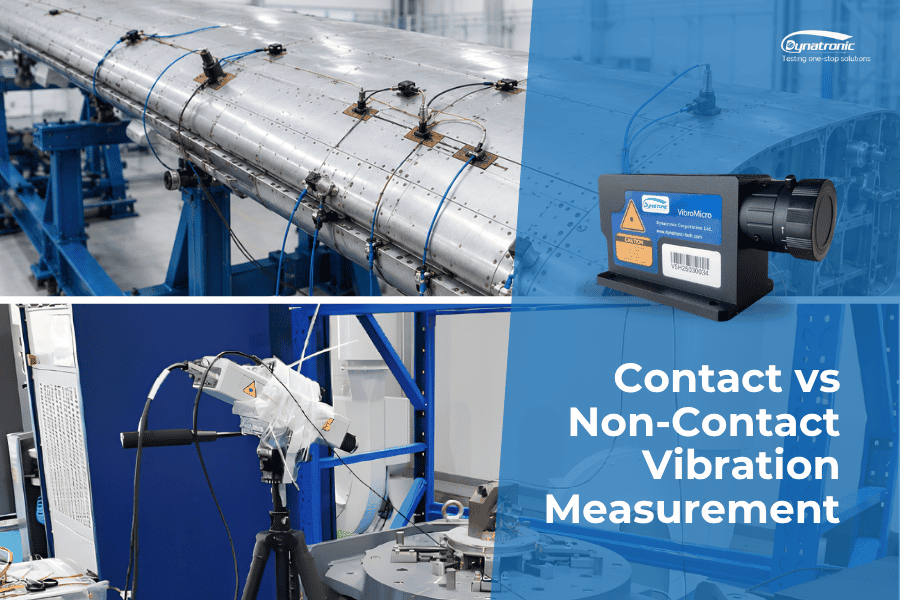
Contact vs Non-Contact Vibration Measurement: Which Method Should Engineers Choose?
Contact vibration measurement uses sensors such as accelerometers mounted directly on the test object. It is widely used for vibration testing, modal analysis, structural testing, rotating machinery monitoring, and product validation.
Non-contact vibration measurement uses optical instruments such as laser Doppler vibrometers to measure vibration remotely, without touching the test object. It is especially useful when the structure is lightweight, hot, rotating, delicate, electrically live, enclosed, difficult to access, or sensitive to added sensor mass.
In many engineering tests, the best solution is not choosing only one method. Contact and non-contact vibration measurement can be used together. Contact accelerometers provide robust reference data, while non-contact laser vibrometers help capture high-resolution vibration data without influencing the structure.
For engineers working in aerospace, automotive, electronics, machinery, civil engineering, and research applications, the key is to choose the measurement method based on the test object, vibration frequency, sensor access, required accuracy, and the risk of disturbing the structure.
Dynatronic supports both measurement approaches through data acquisition systems, contact sensors, VibroMicro laser Doppler vibrometers, and integrated contact/non-contact vibration testing solutions.
Why Vibration Measurement Method Matters
Vibration testing is used to understand how products, structures, and components behave under dynamic conditions.
Engineers use vibration data to evaluate:
Resonance frequencies
Mode shapes
Damping behaviour
Structural fatigue risks
Product reliability
Rotating machinery performance
Acoustic response
Dynamic deformation
Simulation model accuracy
Quality control consistency
However, the quality of vibration data depends heavily on how the measurement is taken.
A sensor that is too heavy can influence the vibration response of a lightweight structure. A sensor that cannot survive heat may fail in aero-engine testing. A cable attached to a rotating part may not be practical. A single measurement point may not be enough to understand a complex mode shape.
This is why engineers should not choose a vibration measurement method only because it is familiar. They should choose it because it fits the test condition.
What Is Contact Vibration Measurement?
Contact vibration measurement uses a physical sensor attached to the test object. The most common sensor is the accelerometer.
Accelerometers measure acceleration at a specific point. They are widely used because they are practical, mature, reliable, and compatible with many vibration test systems and DAQ platforms.
Typical contact vibration sensors include:
IEPE accelerometers
Charge accelerometers
MEMS accelerometers
Velocity sensors
Displacement sensors
Strain gauges for dynamic strain response
Contact measurement is commonly used in:
Machine vibration monitoring
Structural testing
Modal testing
Product validation
Automotive NVH testing
Aerospace component testing
Civil structure monitoring
Rotating machinery diagnostics
Shaker testing
Environmental vibration testing
In many tests, contact sensors remain the most practical and cost-effective choice. They are easy to integrate with DAQ systems, can operate over long test durations, and are well understood by engineers.
Benefits of Contact Accelerometers
1. Proven and widely accepted
Accelerometers are one of the most established tools in vibration testing. Engineers are familiar with their setup, calibration, mounting methods, and data interpretation.
2. Suitable for long-duration monitoring
For machinery, structural health monitoring, and repeated test cycles, contact sensors can remain mounted for continuous or long-term data acquisition.
3. Strong signal stability
When properly mounted, accelerometers provide stable vibration signals and are suitable for many industrial and laboratory test environments.
4. Easy integration with DAQ systems
Contact sensors can be connected directly to data acquisition systems for real-time monitoring, FFT analysis, modal testing, and reporting.
5. Good for rugged environments
Certain accelerometers are designed for harsh industrial, automotive, aerospace, and high-vibration environments.
Limitations of Contact Vibration Measurement
Contact vibration measurement is effective, but it is not ideal for every test.
1. Mass loading can change the result
When an accelerometer is attached to a small, thin, lightweight, or delicate structure, the sensor adds mass to the object. This can change the natural frequency, mode shape, or dynamic response.
For large and rigid structures, this may not be a serious issue. For thin aerospace panels, turbine blades, MEMS devices, small electronics, ultrasonic components, lightweight composites, or precision parts, it can become a major source of error.
2. Sensor mounting takes time
Every contact sensor must be mounted correctly. Engineers may need adhesive, screws, wax, magnetic mounts, clips, or custom fixtures.
If many measurement points are required, setup time can become significant.
3. Repositioning sensors slows down testing
Traditional contact-based vibration testing often requires moving sensors from point to point. This can be time-consuming, especially during modal testing or operational deflection shape analysis.
4. Cables can interfere with the test
Cables may add stiffness, restrict motion, create noise, or become impractical on rotating or moving parts.
5. Contact sensors may not survive extreme environments
High temperature, high voltage, vacuum chambers, enclosed structures, and rotating components can make sensor attachment difficult or impossible.
6. Contact sensors may not be suitable for delicate surfaces
Some components cannot be touched, loaded, scratched, or modified. In these cases, a non-contact method is preferred.
What Is Non-Contact Vibration Measurement?
Non-contact vibration measurement captures vibration without physically attaching a sensor to the object.
The most common high-precision method is laser Doppler vibrometry.
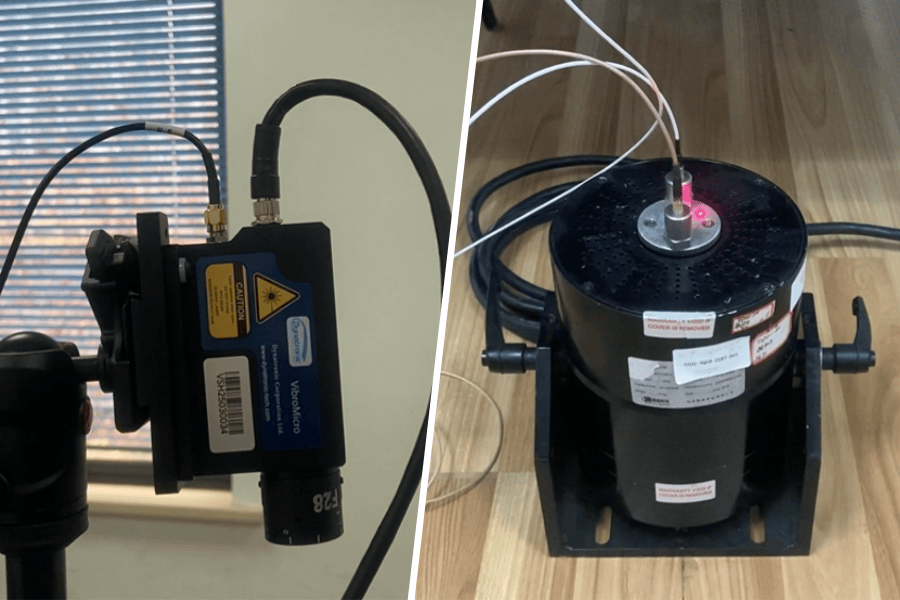
A laser Doppler vibrometer measures vibration by directing a laser beam at the surface of the object. The system detects the Doppler shift in the reflected laser light and converts it into vibration velocity, displacement, or frequency response data.
This allows engineers to measure vibration from a distance without changing the behaviour of the test object.
Dynatronic’s VibroMicro laser vibrometer and VM-S-100 laser vibrometer are designed for precise non-contact vibration testing across applications such as aerospace, electronics, automotive, civil engineering, mechanical equipment, acoustic testing, modal analysis, and micro-vibration measurement.
Laser Doppler Vibrometer Benefits
A laser Doppler vibrometer offers several important advantages for vibration testing.
1. Zero added mass
Because the sensor does not touch the test object, there is no mass loading. This helps engineers capture the true vibration behaviour of lightweight, thin, small, or delicate structures.
2. Suitable for hard-to-access points
A laser vibrometer can measure targets that are difficult to reach with physical sensors, including enclosed components, narrow areas, moving objects, and high-temperature structures.
3. Better for high-temperature applications
In aero-engine, turbine, furnace, or thermal-structural testing, contact sensors may be damaged by heat. A laser vibrometer can measure from a safe distance or through an optical access point.
4. Useful for rotating and moving parts
Non-contact vibration testing is valuable for rotating shafts, blades, motors, fans, turbines, gears, and other components where cables or sensor attachment may be impractical.
5. No surface damage
Delicate structures, membranes, thin panels, MEMS devices, electronics, and precision components can be measured without physical contact.
6. Faster measurement point changes
Engineers can move the laser measurement point without physically removing and reattaching sensors. This improves testing efficiency, especially when many points need to be measured.
7. High spatial resolution
Laser vibrometers can target small areas that may be too small for accelerometer mounting.
8. Suitable for modal and ODS analysis
Non-contact measurement can help engineers capture mode shapes and operational deflection shapes without changing the structure’s dynamic behaviour.
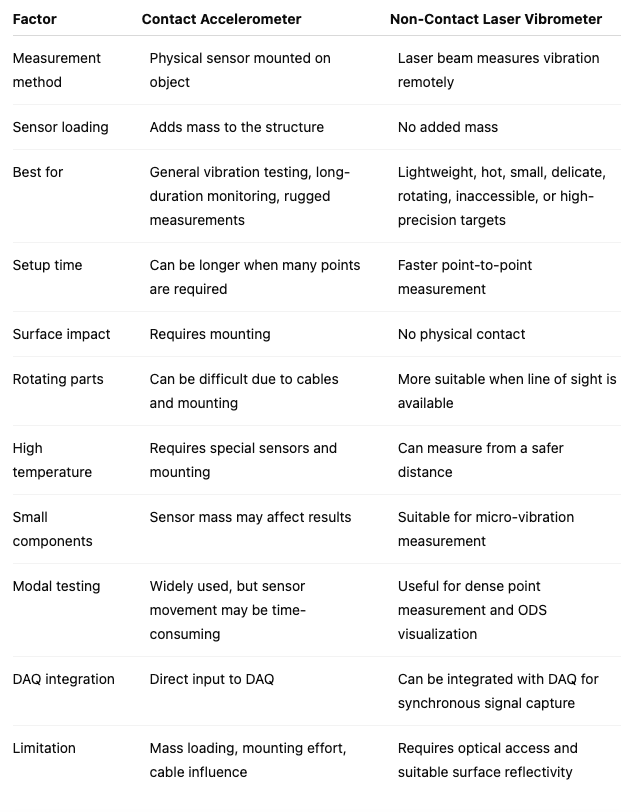
Accelerometer vs Laser Vibrometer: Comparison Table
When to Use Contact Vibration Measurement
Contact accelerometers are usually suitable when:
The test object is large enough that sensor mass does not significantly affect vibration behaviour.
Long-duration monitoring is required.
The sensor can be mounted safely and reliably.
The environment is suitable for physical sensors.
The measurement point is easy to access.
Cabling does not interfere with the test.
The application requires rugged industrial monitoring.
The test setup already uses accelerometer-based DAQ systems.
Common examples include:
Machine vibration monitoring
Shaker table testing
Automotive component testing
Large structure measurement
Industrial equipment diagnostics
General modal testing
Environmental vibration testing
Production validation
Contact measurement remains an important and reliable method. The goal is not to replace accelerometers in every test. The goal is to use them where they provide accurate and practical results.
When to Use Non-Contact Vibration Testing
Non-contact vibration testing is usually the better choice when:
The object is lightweight, thin, or delicate.
Sensor mass may change the vibration response.
The component is hot, electrically live, rotating, moving, or enclosed.
The surface cannot be touched or modified.
Many measurement points are needed quickly.
The target area is too small for sensor installation.
The test requires high spatial resolution.
The engineer needs to avoid cable effects.
The application involves micro-vibration or very small displacement.
The goal is to capture true dynamic behaviour without physical influence.
Common examples include:
Aero-engine blade vibration testing
Thin-walled aerospace panel analysis
MEMS vibration measurement
Ultrasonic tool vibration measurement
Piezoelectric ceramic vibration testing
Speaker and acoustic component testing
Haptic motor testing
LiDAR vibration measurement
Rotating shaft or blade analysis
High-temperature modal testing
Delicate composite material testing
Why Contact and Non-Contact Measurement Are Often Better Together
In many advanced tests, engineers do not need to choose only one method.
A combined contact and non-contact vibration measurement setup can provide a more complete view of the structure.
For example:
Accelerometers can provide reference vibration data.
Laser vibrometers can measure lightweight or sensitive areas without adding mass.
DAQ systems can capture both signal types synchronously.
Engineers can compare contact and non-contact results in one workflow.
Non-contact measurement can reduce time spent physically relocating sensors.
Contact sensors can remain fixed while laser measurement points are moved efficiently.
This combined approach is especially useful in:
Modal testing
Aerospace structural testing
Electronics vibration testing
Product development
Research laboratories
Quality control
Dynamic response analysis
Multi-point vibration measurement
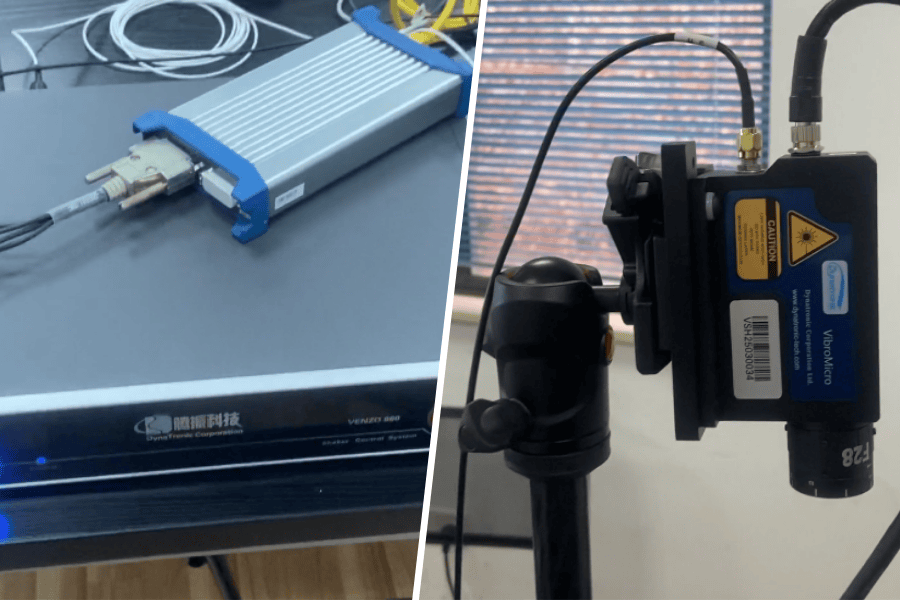
Dynatronic’s DE-884U contact/non-contact application demonstrates this principle by capturing both contact accelerometer signals and non-contact VibroMicro signals. This allows engineers to combine traditional sensor data with laser vibrometer data in a synchronized measurement workflow.
For teams already using contact accelerometers and DAQ systems, adding a VibroMicro laser vibrometer can expand measurement capability without abandoning existing testing methods.
How Non-Contact Measurement Improves Testing Efficiency
One of the biggest practical benefits of laser vibration measurement is speed.
In traditional contact testing, engineers often need to:
Stop the test.
Remove the sensor.
Prepare the next measurement point.
Reattach the sensor.
Check mounting quality.
Reconnect or verify cables.
Restart the test.
Repeat the process for multiple points.
This can consume a significant amount of test time, especially during modal testing, ODS analysis, or multi-point product validation.
With a laser vibrometer, engineers can move the measurement point optically. The sensor does not need to be physically removed or reinstalled.
This helps reduce setup time, improve repeatability, and make it easier to capture vibration data from multiple locations.
For laboratories, R&D teams, and production test environments, this efficiency improvement can directly reduce testing time and support faster engineering decisions.
Aerospace Applications: Why Non-Contact Vibration Measurement Matters
Aerospace testing is one of the strongest use cases for non-contact vibration measurement.
Aerospace components are often:
Lightweight
Thin-walled
High-value
Heat-exposed
Dynamically sensitive
Difficult to access
Subject to strict validation requirements
Designed for extreme operating environments
In these conditions, sensor mass, cable routing, and physical mounting can affect the quality of the test.
Aero-engine blade testing
Turbine and engine blades may operate under high temperature, high pressure, and high-frequency vibration. Contact sensors may not be practical because of heat, small geometry, and mass loading concerns.
Dynatronic’s VibroMicro has been used in high-temperature aero-engine blade vibration testing, where the goal was to capture high-frequency, micro-amplitude vibration without touching the blade.
Thin-walled panel analysis
Aerospace thin-walled panels can be sensitive to added mass. Non-contact laser vibrometry helps engineers observe operational deflection shapes and identify vibration behaviour without physically influencing the panel.
High-temperature modal testing
For materials or components tested under elevated temperature conditions, non-contact laser vibrometers can be positioned away from the heat source while still capturing vibration data from the test specimen.
Aerospace R&D and simulation validation
Accurate vibration data helps engineers validate finite element models, understand structural dynamics, identify fatigue-prone areas, and improve design confidence.
This makes non-contact vibration measurement a valuable tool for aerospace teams working on structural reliability, aeroelastic behaviour, engine development, and advanced material research.
Beyond Aerospace: Where Laser Vibrometers Add Value
Although aerospace is a major application area, non-contact vibration testing is also valuable across other sectors.
Electronics and precision components
VM-S-100 laser vibrometers can support vibration analysis of MEMS, haptic motors, speakers, piezoelectric ceramics, electric shavers, and other small or delicate components.
Automotive testing
Non-contact measurement can be used for LiDAR vibration, power battery vibration response, NVH research, motor testing, and rotating part analysis.
Mechanical equipment
Laser vibrometers can measure ultrasonic tools, machining tips, solder joints, rotating parts, and precision mechanical assemblies.
Civil engineering
Long-distance, non-contact vibration measurement can support structural vibration analysis of bridges, towers, and critical infrastructure.
Research and education
Universities and laboratories can use contact and non-contact measurement together for modal analysis, structural dynamics, material testing, and advanced experimental research.
How to Choose Between an Accelerometer and a Laser Vibrometer
Use the following checklist before selecting the measurement method.
Choose a contact accelerometer when:
The structure is large and rigid enough for sensor mounting.
The sensor mass will not significantly affect the result.
The test requires long-term fixed-point monitoring.
The environment is suitable for a physical sensor.
The measurement point is easy to access.
The budget requires a practical and established method.
The test setup already uses accelerometer-based DAQ.
Choose a laser vibrometer when:
The structure is lightweight, thin, small, or delicate.
The object is hot, rotating, moving, electrically live, or enclosed.
Sensor mounting may damage the surface.
Cable routing is difficult or impossible.
The test requires fast movement between measurement points.
Many measurement points are needed.
The test requires high-resolution displacement or velocity measurement.
The engineer needs true dynamic behaviour without mass loading.
Choose both when:
You need reference accelerometer data and high-resolution non-contact data.
You want to compare sensor methods.
You need synchronized multi-signal acquisition.
You are performing modal testing or ODS analysis.
You want to improve efficiency without removing your existing DAQ workflow.
You need to measure both accessible and inaccessible points in the same test.
DAQ Integration: Why the Measurement System Matters
A sensor alone does not complete the vibration test.
For useful engineering results, vibration signals must be captured, synchronized, monitored, analyzed, stored, and reported correctly.
This is where the DAQ system becomes critical.
A good vibration measurement system should support:
Contact sensor input
Non-contact laser vibrometer input
Synchronous acquisition
High-speed dynamic signal capture
Signal conditioning
Real-time monitoring
Frequency analysis
Modal analysis support
Data export
Scalable channel configuration
Repeatable test workflows
Dynatronic’s measurement ecosystem is designed around this need. Engineers can combine data acquisition systems, VibroMicro laser vibrometers, accelerometers, strain measurement systems, rugged recorders, wireless data recording systems, and software according to the application.
For contact/non-contact vibration testing, a DAQ system such as the DE-884U can help engineers capture signals from both traditional accelerometers and laser vibrometers in one workflow.
This is important because engineers do not only need more data. They need aligned, reliable, and comparable data.
Recommended Dynatronic Solutions
VibroMicro Laser Doppler Vibrometer
VibroMicro is suitable for high-precision, non-contact vibration measurement in applications where physical sensor mounting is difficult, risky, or likely to affect the result.
Use VibroMicro for:
Non-contact vibration testing
Micro-vibration measurement
High-temperature applications
Aerospace blade testing
Modal analysis
ODS analysis
Delicate or lightweight structures
Rotating or hard-to-access components
Research and product validation
VibroMicro VM-S-100 Laser Vibrometer
VM-S-100 is suitable for compact, precise, non-contact vibration measurement across electronics, automotive, mechanical, aerospace, acoustic, and civil engineering applications.
Use VM-S-100 for:
MEMS testing
Haptic motor vibration
Speaker and acoustic component testing
Piezoelectric ceramic vibration
LiDAR vibration monitoring
Structural vibration measurement
Small component vibration analysis
Quality control and R&D validation
DE-884U Dynamic Signal Test and Analysis System
DE-884U is suitable for contact and non-contact vibration measurement workflows where engineers need flexible, synchronous, multi-channel data acquisition.
Use DE-884U for:
Contact accelerometer acquisition
VibroMicro signal acquisition
Combined contact/non-contact vibration testing
Modal and dynamic signal testing
Distributed measurement setups
Multi-point structural vibration analysis
Research and laboratory testing
Common Mistakes in Vibration Measurement Selection
Mistake 1: Choosing accelerometers for every test by default
Accelerometers are useful, but they are not always the best choice for lightweight, hot, small, delicate, or rotating structures.
Mistake 2: Ignoring mass loading
If the sensor changes the object’s dynamic behaviour, the measurement result may not represent the true structure.
Mistake 3: Treating non-contact measurement as only a special tool
Laser vibrometers are not only for unusual tests. They can also improve efficiency, accuracy, and repeatability in everyday R&D and production testing.
Mistake 4: Measuring only one point when the structure needs many
Complex structures often require multiple measurement points to understand mode shapes, deformation patterns, or vibration distribution.
Mistake 5: Separating contact and non-contact data workflows
If contact and non-contact signals are captured separately without proper synchronization, comparison becomes harder. A unified DAQ workflow helps engineers interpret results more confidently.
Conclusion: The Best Vibration Measurement Method Depends on the Test
Contact and non-contact vibration measurement are both valuable.
Contact accelerometers remain a proven, practical choice for many vibration tests. They are reliable, widely used, and suitable for many industrial, automotive, structural, and laboratory applications.
Non-contact laser vibrometers are the better choice when engineers need to measure without touching the object. They are especially useful for lightweight structures, high-temperature components, rotating parts, delicate surfaces, micro-vibration, modal analysis, and aerospace applications.
For many advanced tests, the strongest approach is to combine both.
Dynatronic helps engineers build vibration measurement systems around the real test requirement, not only around one sensor type. With VibroMicro laser vibrometers, VM-S-100 compact laser vibrometers, DE-884U data acquisition systems, accelerometers, sensors, and analysis software, Dynatronic supports both contact and non-contact vibration testing across demanding engineering applications.
If your team needs to compare accelerometers and laser vibrometers, improve vibration test efficiency, or design a contact/non-contact DAQ setup, Dynatronic can help configure the right measurement solution.
Need help choosing between contact accelerometers and non-contact laser vibration measurement?
Talk to Dynatronic about your test object, measurement points, frequency range, environment, and DAQ requirements. Our team can help you select the right contact, non-contact, or combined vibration measurement setup for your application.
FAQs
-
Contact vibration measurement uses a physical sensor, such as an accelerometer, mounted directly on the test object. Non-contact vibration measurement uses an optical system, such as a laser Doppler vibrometer, to measure vibration remotely without touching the object.
-
A laser vibrometer is better when the object is lightweight, small, delicate, hot, rotating, enclosed, or sensitive to added mass. An accelerometer is often better for rugged, fixed-point, long-duration, or general vibration monitoring. The best choice depends on the test.
-
The main benefits include zero added mass, non-contact measurement, suitability for hard-to-access points, fast measurement point changes, high spatial resolution, and the ability to measure hot, rotating, delicate, or lightweight structures.
-
Mass loading happens when the weight of a mounted sensor changes the vibration behaviour of the test object. This can shift resonance frequencies, alter mode shapes, or reduce measurement accuracy, especially on lightweight structures.
-
Engineers should use non-contact vibration testing when physical sensor mounting may affect the result, damage the object, create cabling problems, or become impossible due to heat, movement, rotation, size, or access limitations.
-
Yes. Contact accelerometers and non-contact laser vibrometers can be used together in one vibration measurement workflow. This allows engineers to combine fixed reference sensors with flexible non-contact measurement points.
-
Aerospace components are often lightweight, thin-walled, high-temperature, and dynamically sensitive. Non-contact laser vibrometers help measure vibration without adding mass or interfering with the structure, which is important for aero-engine blades, thin panels, modal testing, and structural validation.
-
Dynatronic VibroMicro is used for high-precision non-contact vibration measurement, including aerospace testing, modal analysis, high-temperature testing, micro-vibration measurement, rotating component analysis, and product validation.
-
The VM-S-100 is used for compact non-contact vibration measurement in applications such as MEMS testing, haptic motor analysis, speaker testing, piezoelectric ceramic vibration measurement, LiDAR vibration monitoring, structural vibration analysis, and R&D validation.
-
Dynatronic’s DE-884U can support contact and non-contact vibration measurement workflows by capturing signals from traditional contact sensors and laser vibrometers for synchronized dynamic signal analysis.