
Pin Force Sensors for Compact and Accurate Load Measurement
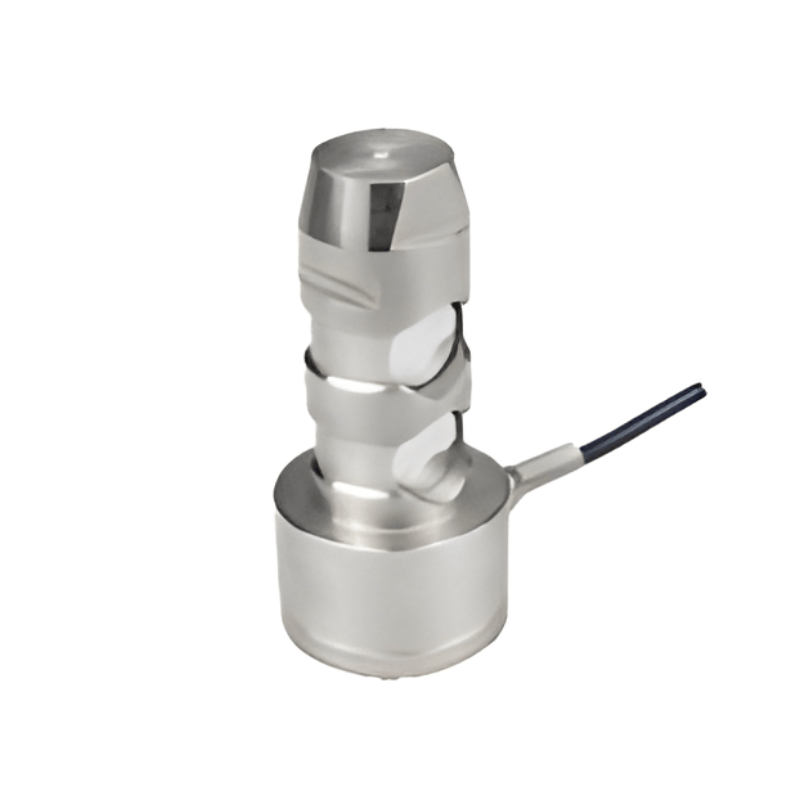
The Pin Force Sensor is a compact and robust force measurement device designed to accurately measure tensile and compressive forces transmitted through mechanical joints, linkages, and structural connections. By replacing a standard mechanical pin or bolt, the pin force sensor enables direct force measurement without altering the original mechanical design or load path. This makes it an ideal solution for applications where space is limited and traditional load cells are difficult to integrate.
Pin force sensors are commonly used in structural testing, machinery monitoring, and industrial measurement applications where real-time force data is required under real operating conditions. Their discreet form factor allows force measurement to be embedded directly into existing assemblies, providing realistic and representative data.
Measurement Principle
Pin force sensors typically operate using strain gauge technology. Precision strain gauges are bonded to the internal body of the pin and arranged in a Wheatstone bridge configuration. When force is applied through the pin, it experiences microscopic elastic deformation. This deformation causes a proportional change in the electrical resistance of the strain gauges, which is converted into a stable electrical output representing the applied force.
Because the sensor measures force directly within the load path, the measurement is highly accurate and repeatable. The design ensures that forces are evenly distributed across the sensing element, minimizing sensitivity to bending or off-axis loads.
Key Characteristics
Pin force sensors offer high accuracy, excellent linearity, and low hysteresis across their rated load range. They are available in multiple force capacities to support both low-force precision applications and higher-load industrial systems. The compact cylindrical design allows easy installation in clevis joints, hinges, linkages, and pivot points.
Rugged construction ensures reliable operation in environments subject to vibration, shock, and temperature variation. Because the sensor replaces an existing pin, installation is straightforward and does not require major mechanical modification.
Typical Applications
Pin force sensors are widely used in:
Structural Load Monitoring: Measuring forces in joints, connections, and load-bearing elements
Industrial Machinery: Monitoring force transmission in linkages, actuators, and mechanisms
Automotive & Transportation: Suspension testing, linkage force measurement, and component validation
Aerospace & Defense: Load measurement in control systems and structural assemblies
Research & Education: Experimental force measurement in mechanical systems
In many of these applications, pin force sensors provide valuable insight into real-world loading conditions that cannot be easily captured using external load cells.
Integration with Measurement Systems
Pin force sensors are designed for seamless integration with Dynatronic data acquisition and monitoring systems. When synchronized with parameters such as displacement, strain, vibration, or acceleration, force data enables deeper analysis of system behavior. This multi-parameter approach helps engineers validate designs, identify overload conditions, and improve overall system reliability.
Practical Force Measurement in Compact Spaces
By combining precision force sensing with a compact, pin-style design, pin force sensors deliver reliable force measurement without compromising mechanical integrity. They are an effective solution for engineers who need accurate, real-time force data directly within structural and mechanical assemblies.
 |
 |
|||||||||
|---|---|---|---|---|---|---|---|---|---|---|
| Type Number | DT3F211 | DT3F212 | ||||||||
| Range | 5kN | 10kN | 20kN | 30kN | 40kN | 50kN | 70kN | 100kN | 150kN | 200kN |
| Zero Point Output | ±1%FS | ±1%FS | ±1%FS | ±1%FS | ±1%FS | ±1%FS | ±1%FS | ±1%FS | ±1%FS | ±1%FS |
| Nonlinear | ±0.5%FS | ±0.5%FS | ±0.5%FS | ±0.5%FS | ±0.5%FS | ±0.5%FS | ±0.5%FS | ±0.5%FS | ±0.5%FS | ±0.5%FS |
| Lag | ±0.5%FS | ±0.5%FS | ±0.5%FS | ±0.5%FS | ±0.5%FS | ±0.5%FS | ±0.5%FS | ±0.5%FS | ±0.5%FS | ±0.5%FS |
| Repetitiveness | ±0.5%FS | ±0.5%FS | ±0.5%FS | ±0.5%FS | ±0.5%FS | ±0.5%FS | ±0.5%FS | ±0.5%FS | ±0.5%FS | ±0.5%FS |
| Operating Temperature | -30°C~+70°C | -30°C~+70°C | -30°C~+70°C | -30°C~+70°C | -30°C~+70°C | -30°C~+70°C | -30°C~+70°C | -30°C~+70°C | -30°C~+70°C | -30°C~+70°C |