
RU-846 in the Mengzhou Abort Flight Test
1. Project Background
On June 17, 2025, China successfully conducted the Mengzhou manned spacecraft zero-altitude abort flight test at the Jiuquan Satellite Launch Centre. This marked the first such test in 27 years, following the Shenzhou spacecraft zero-altitude abort flight test carried out in 1998. The complete success of the test represents a significant new breakthrough in the development of China’s manned lunar exploration programme and establishes an important technical foundation for future crewed lunar missions.
The Mengzhou manned spacecraft is a new-generation, domestically developed crewed transport vehicle for future space missions. It adopts a modular design and can carry up to seven astronauts, with overall performance reaching internationally advanced levels. Compared with the Shenzhou spacecraft, the Mengzhou changes the previous mode where “the launch vehicle is responsible for abort and the spacecraft for emergency survival”. Instead, the spacecraft system takes overall responsibility for the abort function, covering both escape and survival tasks. This test comprehensively assessed the escape and survival subsystem of the Mengzhou spacecraft and its associated large systems, verifying the correctness and compatibility of the abort timing, separation sequences, and closed-loop abort trajectory control, while also acquiring real flight abort parameters.
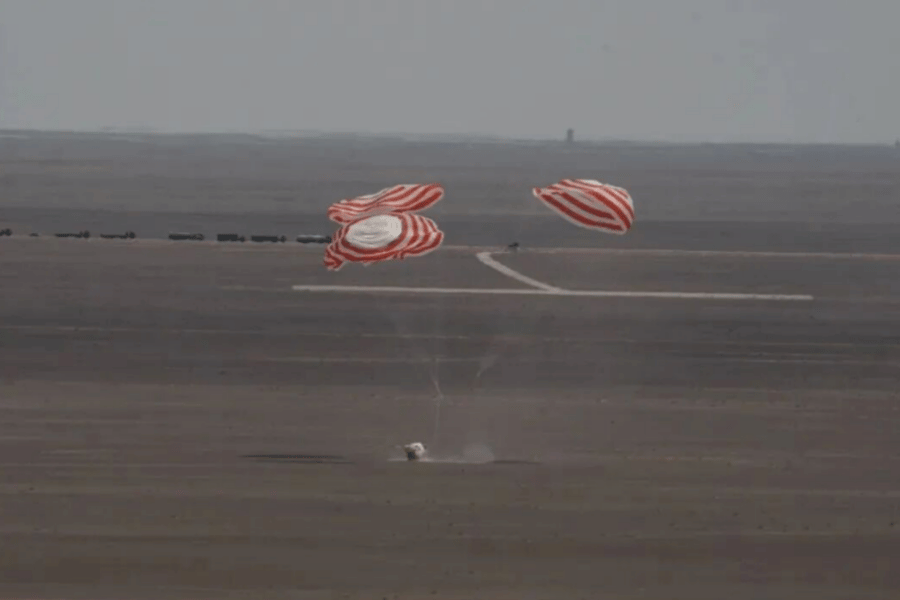
Abort and emergency survival are among the most critical safety guarantees for manned missions. In the event of an emergency failure, the system must carry the crew-carrying return capsule away from the hazardous zone and ensure the astronauts’ safe return to Earth. This zero-altitude abort flight test was a key verification of the spacecraft’s abort system performance, featuring new configurations, high difficulty, and significant risks. During the test, the combined vehicle-tower assembly lifted off from zero altitude under the thrust of solid rocket motors. Approximately 20 seconds later, it reached the predetermined altitude, the return capsule successfully separated from the escape tower, and the parachutes deployed properly. The return capsule then landed safely at the predetermined landing zone using an airbag cushioning system. The entire flight lasted only a short time, and the dynamic environment was extremely harsh, imposing very high demands on the data acquisition system.
2. Test Requirements and Challenges
The flight profile of the zero-altitude abort test presents the following notable challenges:
2.1. Severe shock and high overload environment. At the moment of escape motor ignition, a thrust of several hundred tonnes is generated, accelerating the vehicle-tower combination from zero to high speed within a very short period. The structure experiences intense shock and overload. Sensors installed at key locations such as the escape tower and the return capsule must operate reliably under these extreme mechanical conditions and accurately record data.
2.2. High-frequency response and simultaneous acquisition of multiple signal types. The test requires synchronous acquisition of various dynamic signals, including low- and high-frequency structural vibrations, stress/strain changes, high-frequency shocks generated during separation mechanism operation, flight overloads, aerodynamic pressures, and engine noise. Different signal types impose different requirements on sampling rate, range, and signal conditioning.
2.3. Extremely limited installation space. The internal equipment density within the escape tower and return capsule leaves very little room for test instrumentation, making it difficult to deploy conventional data acquisition equipment.
2.4. Data reliability under extreme conditions. The abort flight test is a one-time event; data cannot be reproduced. Under severe vibration, high shock, and possible abnormal conditions, it is essential to ensure the integrity and recoverability of the acquired data.
3. Solution: RU-846 Rugged Micro Dynamic Signal Test and Analysis System
To meet these stringent testing requirements, the RU-846 Rugged Micro Dynamic Signal Test and Analysis System was selected for this test. The system is developed by Dynatronic and is specifically designed for reliable testing in confined installation spaces and harsh environments such as wide temperature ranges, strong vibration, and high shock—typical of vehicle-borne and airborne applications.
3.1 Key System Features
Miniaturised and lightweight design. The RU-846 system features an aluminium-alloy housing. The 16-channel version measures only 55 mm × 62 mm × 82 mm and weighs just 350 grams. This allows flexible deployment in the densely packed areas of the escape tower and return capsule, minimising any impact on the vehicle’s structure and centre of gravity.
Excellent shock resistance and wide-temperature operation. The system can operate reliably for extended periods under high-intensity shock up to 500 g and over a wide temperature range from –40 °C to +60 °C (with an optional low-temperature battery). It fully meets the extreme conditions encountered during abort motor ignition, aerodynamic heating, and other phases of the test.
Flexible modular combination. The system supports IEPE, charge, and strain measurement modules that can be customised and combined. A single system supports up to four layers (16 channels) of modules. Using a USB hub, a single computer can achieve synchronous parallel testing and analysis for up to 96 dynamic signal channels. This capability enables simultaneous connection to various sensor types—vibration, shock, strain, overload, pressure, and noise—for multi-dimensional synchronous data acquisition.
High sampling rate and large data storage. The system is equipped with 32 GB of high-speed internal storage. In online sampling mode, a single 16-channel unit can achieve synchronous sampling at up to 128 kHz per channel. Multiple units can be precisely synchronised using a synchronisation clock module, ensuring time consistency across all measurement points.
3.2 Data Acquisition Scheme
In this test, the RU-846 system, together with appropriate sensors, was installed at critical locations on the escape tower and return capsule to acquire real-time multi-dimensional data throughout the entire flight:
• Structural vibration monitoring: IEPE vibration acquisition modules (ranges ±5 V, ±500 mV, ±50 mV; frequency response 1 Hz–20 kHz) were used to capture low- and high-frequency vibration responses of the escape tower and return capsule during motor operation and separation.
• Stress/strain monitoring: Strain measurement modules (strain range ±50,000 με to ±2,500 με; bridge excitation 2 V DC; supporting full bridge, half bridge, and 3-wire quarter bridge) monitored stress/strain variations in key structures during flight.
• High-frequency shock monitoring: Charge measurement modules (ranges ±5,000 pC, ±500 pC, ±50 pC, etc.; frequency response 0.5 Hz–20 kHz) recorded high-frequency shock signals generated during the operation of separation mechanisms.
• Overload and aerodynamic pressure monitoring: Appropriate sensors were connected to capture flight overload and aerodynamic pressure data.
• Noise monitoring: Engine noise signals during motor operation were acquired.
4. Key Technology: Dual-Line Backup Data Storage
Given the special flight conditions of this test, the RU-846 system employed a dual-line backup data storage approach. The core value of this technical solution lies in:
4.1. Data redundancy assurance. The system simultaneously writes data to two independent storage media during acquisition. If one storage medium fails due to extreme shock, vibration, or abnormal conditions, the other retains the complete data, effectively preventing data loss caused by a single point of failure.
4.2. Data recoverability under extreme conditions. During the abort flight test, phases such as return capsule/escape tower separation, parachute deployment, and airbag-cushioned landing all involve severe mechanical environments. The dual-line backup ensures that even if one storage device is physically damaged, the complete test data can still be recovered from the backup channel.
4.3. Guarantee of test data integrity. As a one-time flight test, the acquired abort flight parameters are the primary basis for verifying the correctness of the spacecraft’s abort system design. The backup mechanism provides a strong safeguard for complete data recovery, adding a critical layer of redundancy to the success of the test.
5. Application Results
During the Mengzhou manned spacecraft zero-altitude abort flight test, the RU-846 Rugged Micro Dynamic Signal Test and Analysis System successfully accomplished the following:
• Full-flight data acquisition: From escape motor ignition to the safe landing of the return capsule (approximately 2 minutes in total), the system performed synchronous, uninterrupted multi-channel data acquisition across multiple signal types.
• Stable operation under extreme conditions: Under severe shock from hundreds of tonnes of thrust, high overloads, and wide temperature variations, the system remained stable throughout, with no data interruption or equipment failure.
• Complete data recovery: Thanks to the dual-line backup mechanism, all flight data—including vibration, shock, strain, overload, pressure, noise, and other multi-dimensional parameters—were fully recovered. This provided comprehensive and reliable data support for post-test analysis and abort system performance evaluation.
6. Conclusion
The success of the Mengzhou manned spacecraft zero-altitude abort flight test is a significant milestone in China’s manned lunar exploration programme. The RU-846 Rugged Micro Dynamic Signal Test and Analysis System, with its miniaturised design, outstanding environmental adaptability, flexible modular configuration, and innovative dual-line backup data storage technology, successfully accomplished the real-time acquisition and reliable storage of multi-dimensional dynamic signals under extremely harsh test conditions.
This application fully validates the capability of the RU-846 system in data acquisition and assurance for major aerospace engineering tests, demonstrating the technical strength of domestically produced test instrumentation in high-end equipment development such as manned spaceflight. As China’s manned lunar exploration programme progresses, the RU-846 system and its subsequent products are expected to play an important role in more spacecraft ground tests, flight tests, and on-orbit operations, providing solid data support for the development of these national-priority projects.
