
Non-Contact Vibration Measurement with Dynatronic VibroMicro
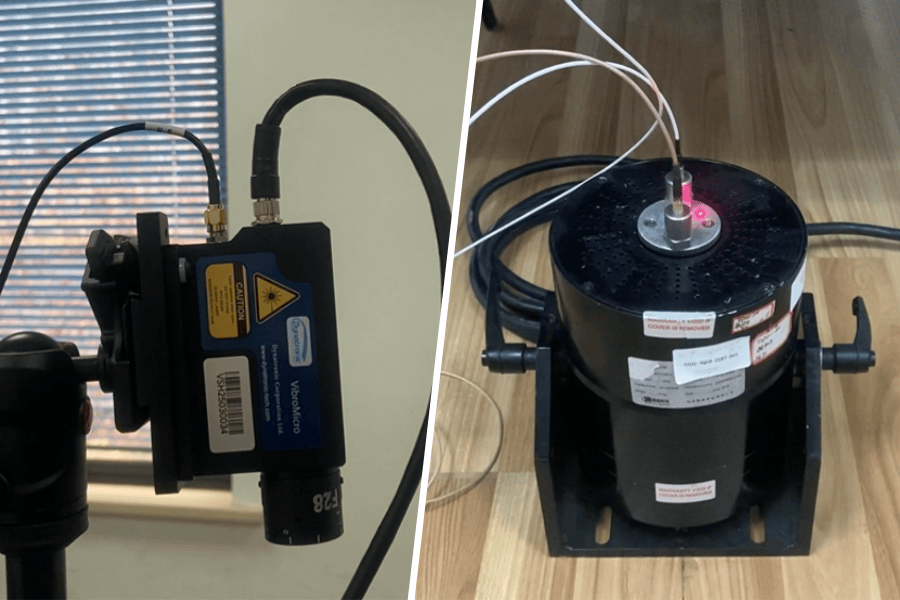
The vibration control system consisting of DTC VENZO800 vibration controller and Dynatronic VibroMicro
Compared with traditional contact-type vibration accelerometers, the core advantage of the Dynatronic VibroMicro as a non-contact accelerometer (effectively a laser vibrometer) is that it completely eliminates physical contact between the sensor and the object being measured. This brings revolutionary improvements in measurement accuracy, application scope, and operational efficiency.
1. Core Advantage: Zero Added Mass for True Data
Traditional accelerometers must be attached to the test object using studs, magnetic bases, or adhesive. The mass of the sensor itself can alter the vibration characteristics of lightweight or small structures. This is known as the "mass loading effect." For micro-components like MEMS devices, micro-bearings, or precision tools, this influence can render the measurement data inaccurate.
VibroMicro Advantage: It utilizes the laser Doppler principle for completely non-contact measurement. It applies zero added mass to the test object, capturing the structure's true vibration behavior—something contact sensors cannot achieve.
2. Technical Parameter Comparison: Superiority in Precision and Range
The VibroMicro typically surpasses traditional contact sensors in key performance indicators, especially in applications demanding high precision and high-frequency response.
| Aspect | VibroMicro Non-Contact Laser Vibrometer | Traditional Contact Accelerometer |
|---|---|---|
| Measurement Principle | Laser Doppler effect, non-contact | Piezoelectric/Capacitive, requires contact |
| Added Mass | Zero, no mass loading effect | Yes, can alter characteristics of light/small structures |
| Displacement Resolution | Up to 0.001 nm (nanometer level) | Limited, requires integration which can introduce errors |
| Frequency Range | DC (0 Hz) to 25 MHz (up to GHz level) | Typically 0.1 Hz to 20 kHz (industrial grade) |
| Dynamic Range | >100 dB, linearity error <1% | 60-80 dB, linearity error 1%-5% |
| Environmental Adaptability | Suitable for high temperature, vacuum, corrosive environments | Sensitive to EMI, temperature drift; requires protection |
3. Application Advantages: Overcoming Physical Limitations of Contact Measurement
Adapting to Extreme/Hazardous Environments: The VibroMicro excels where traditional sensors cannot function. For example, in high-temperature, vacuum, or strong acid/alkali environments, or when monitoring live high-voltage power lines, operators can perform measurements from a safe distance, completely eliminating the risk of electric shock and complex power-off procedures.
Enabling High-Frequency Micro-Vibration & Large Structure Measurements: Thanks to its ultra-wide frequency range (DC to 25MHz) and nanometer resolution, the VibroMicro can precisely capture the high-frequency micro-vibrations of MEMS devices or ultrasonic welding tools. Furthermore, integrated with robotics, it enables automated scanning measurements of large structures like car bodies or wind turbine blades.
Boosting Efficiency and Simplifying Workflow: Non-contact measurement eliminates sensor installation time, drastically reducing setup time. The visible red laser spot allows for precise positioning of measurement points, significantly enhancing efficiency for multi-point applications like modal analysis.
Summary
In summary, the Dynatronic VibroMicro overcomes the fundamental limitations of contact accelerometers—namely, "added mass" and "physical contact"—through its non-contact measurement approach. When the test object is lightweight, delicate, small, high-temperature, electrically live, or otherwise difficult to access, and when there is a high demand for measurement accuracy, frequency range, and data fidelity, the VibroMicro represents a more advanced and reliable choice than traditional accelerometers.
