
DE-884U Captures Contact and Non-Contact Signals
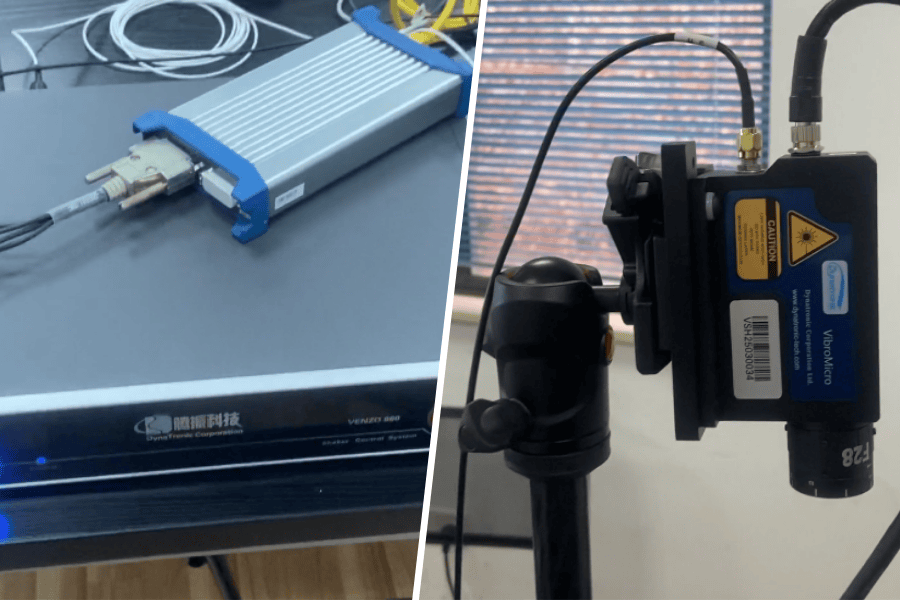
In many traditional vibration tests, engineers rely on data acquisition (DAQ) systems paired with contact accelerometers to measure vibration levels across different points on a structure. While effective, this approach often comes with a major drawback: the time and effort required to install, remove, and reposition sensors.
For modal testing or scanning applications involving dozens—or even hundreds—of measurement points, sensor setup can consume more than half of the total testing time. Wiring complexity and repeated repositioning significantly reduce efficiency and slow down project timelines.
The Dynatronic VibroMicro Non-Contact Laser Vibrometer can fundamentally change this situation from the following aspects, helping customers complete tests more conveniently and efficiently:
1. Instant Measurement Point Switching, Eliminating Installation Time
Traditional Pain Point: Every time a contact accelerometer is moved, it requires: ① Removing the original sensor; ② Cleaning the mounting surface; ③ Re-fixing it (glue/magnet/stud); ④ Reconnecting and checking the cable. The entire process can take several minutes or more.
VibroMicro Advantage: Simply point the laser head at the new measurement spot. Switching time is reduced from minutes to seconds. For tests requiring a large number of points (like modal analysis or vibration/noise testing), the efficiency improvement is revolutionary.
2. Conquering "Inaccessible" Measurement Areas
Traditional accelerometers are simply impossible to use in some scenarios, whereas the non-contact nature of the VibroMicro handles them with ease:
Lightweight/Small Structures: Such as micro-circuit boards, MEMS devices, guitar strings, or precision tools. The weight of a contact sensor can alter their vibration characteristics (mass loading effect), distorting the data. Laser measurement has zero mass loading.
High-Temperature/Electrically Live/Rotating/Enclosed Objects: For example, engine turbine blades, high-voltage busbars, high-speed rotating shafts, or components inside a vacuum chamber. These environments either damage sensors or make wiring impossible. Lasers can measure through viewports or from a safe distance.
3. Enabling Multi-Channel Non-Contact Vibration Control and Measurement
The "multi-channel non-contact vibration control and measurement" you mentioned is a core strength of the VibroMicro system, elevating testing capability from "single-point recording" to "full-field control":
Parallel Multi-Channel Measurement: By using multiple VibroMicro sensor heads, vibrations at several key locations can be monitored simultaneously. This is crucial for Multi-Input Multi-Output (MIMO) control or monitoring multiple response points on large structures.
Closed-Loop Vibration Control: In applications like active vibration control or material testing, the VibroMicro can act as a non-contact feedback sensor. It transmits real-time vibration signals back to the Dynatronic DAQ system, allowing a controller to adjust the shaker output, forming a complete closed-loop control loop without any physical influence on the specimen.
Fully Automated Scanning: Using galvanometer mirrors and software, the VibroMicro can automatically measure across a pre-defined grid of points, generating an animation of the mode shape for the entire surface. This is orders of magnitude faster and provides much higher spatial resolution than manually repositioning dozens of accelerometers.
Summary
For long-time customers accustomed to using Dynatronic DAQ + contact accelerometers, introducing the VibroMicro Non-Contact Laser Vibrometer means:
Explosive Efficiency Gains: Transforming the tedious process of sensor installation into a simple point-and-measure operation.
Expanded Capabilities: Enabling measurements in previously impossible locations (small, hot, hazardous, or inaccessible objects).
Dimensional Upgrade: Advancing from limited-point contact measurements to high-density scanning or multi-channel non-contact control, resulting in more comprehensive and accurate vibration data.
