
Attitude and Heading Systems for Industrial Testing
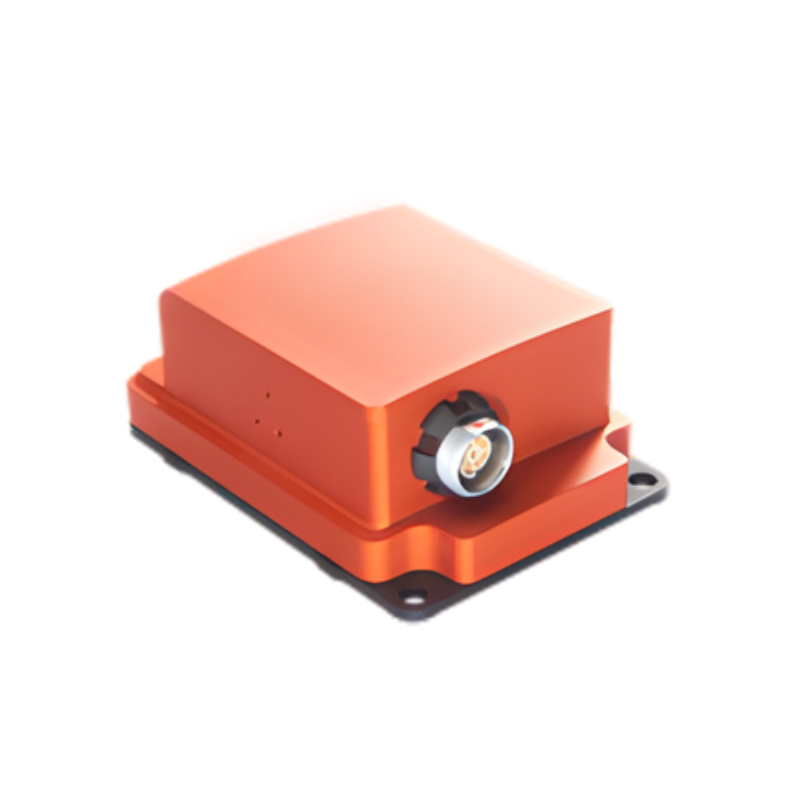
The Attitude and Heading Reference System (AHRS) is an advanced inertial sensing solution designed to provide accurate orientation, attitude, and heading information in real time. By continuously estimating roll, pitch, and yaw, an AHRS enables systems to understand their spatial orientation and motion, which is essential in dynamic testing, navigation-related applications, and motion monitoring environments.
An AHRS integrates multiple sensing elements—typically gyroscopes, accelerometers, and magnetometers—into a single compact unit. Through sensor fusion algorithms, data from these sensors is combined to produce stable and drift-controlled orientation outputs. This allows the system to maintain reliable attitude and heading information even in the presence of vibration, acceleration, and changing motion conditions.
Measurement Principle
Gyroscopes measure angular rate, providing short-term orientation stability and responsiveness. Accelerometers sense gravity and linear acceleration, helping correct long-term drift and determine pitch and roll. Magnetometers detect the Earth’s magnetic field, supplying a reference for heading relative to magnetic north. Sensor fusion algorithms continuously process these inputs to compensate for noise, bias, and drift, resulting in consistent and accurate orientation data.
This combination makes AHRS technology highly effective for applications where pure inertial sensors alone would accumulate error over time, but full navigation-grade systems would be unnecessary or overly complex.
Key Characteristics
Attitude and Heading Reference Systems offer fast response, stable output, and good resistance to environmental influences such as vibration and temperature variation. Compact size and low power consumption allow easy integration into both fixed installations and mobile platforms. The predictable and repeatable output makes AHRS units suitable not only for operational use but also for testing, validation, and experimental measurement setups.
Because orientation data is delivered in real time, AHRS units can support monitoring, feedback control, and post-test analysis with minimal system overhead.
Typical Applications
AHRS solutions are widely used across industries, including:
Industrial Motion Monitoring: Tracking orientation and movement of machinery, platforms, or structures
Robotics & Automation: Providing attitude feedback for mobile robots and articulated systems
Automotive & Transportation: Measuring vehicle dynamics, tilt, and heading behavior
Aerospace & UAV Testing: Supporting flight testing, stability analysis, and motion evaluation
Education & Research: Teaching inertial sensing principles and conducting motion-related experiments
In many of these applications, AHRS data is combined with other measurements to deliver a more complete understanding of system behavior.
Integration with Measurement Systems
The AHRS is designed for seamless integration with Dynatronic data acquisition and monitoring systems. When synchronized with parameters such as vibration, force, strain, velocity, or temperature, orientation data adds valuable context to test results. This multi-parameter approach enables engineers to correlate motion with mechanical or environmental effects, supporting deeper analysis and more confident decision-making.
Reliable Orientation Insight
By delivering accurate and stable attitude and heading information in a compact and efficient format, the Attitude and Heading Reference System provides practical orientation insight for testing, monitoring, and motion analysis applications. It is a versatile tool for engineers who need dependable spatial data without the complexity of full navigation systems.
The DTMTi-300 is a high-performance AHRS capable of capturing high-frequency dynamic attitudes with excellent stability. It integrates a vibration-resistant gyroscope to maintain high-quality inertial data even in harsh environments, and supports temperature compensation, high-frequency output, and third-party synchronization. Fully compatible with the DTMTi-100 series SDK, drivers, and source code, it offers a smooth integration path for advanced navigation systems.
 |
|
|---|---|
| Type Number | DTMTi-300 |
| Sensor Performance | |
| Longitudinal tilt, transverse roll | 0.2° |
| Heading Angle | 1° |
| Jielian System | Yes |
| Magnetic Sensor | |
| Full scale | +/-8G |
| All RMS noise | 0.5mG |
| Nonlinearity | 0.2% |
| Resolution | 0.25mG |
| Gyroscope | |
| Full scale | 450°/s |
| Zero-bias stability | 10°/h |
| Bandwidth | 415Hz |
| Noise density | 0.01°/s/√Hz |
| Influence of heavy acceleration | 0.003°/s/g |
| Electrical Performance | |
| Input voltage | 3.3V, 4.5V–34V |
| Power consumption | 520mW |
| Accelerometer | |
| Full scale | 20g |
| Zero-bias stability | 15μg |
| Bandwidth | 375Hz |
| Noise density | 60μg/√Hz |
The DTMTi-670G is a compact IP68-rated GNSS/INS module with support for an external GNSS receiver, providing sub-meter positioning and reliable motion tracking. Easy to integrate and designed for tough environments, it offers a simple, high-precision solution for systems requiring both inertial attitude data and accurate global positioning.
 |
|
|---|---|
| Type Number | DTMTi-670G |
| IMU Performance | |
| Longitudinal tilt, transverse roll | 0.2° |
| Heading Angle | 0.8° |
| Position | <1m |
| Speed | 0.05m/s |
| Magnetic Sensor | |
| Full scale | Full scale |
| All RMS noise | 1mG |
| Nonlinearity | 0.2% |
| Resolution | 0.25mG |
| Gyroscope | |
| Full scale | 2000°/s |
| Zero-bias stability | 8º/h |
| Bandwidth | 520Hz |
| Noise density | 0.007º/s/√Hz |
| Influence of gravity acceleration | 0.001º/s/g |
| GNSS Receiver | |
| Brand | u-blox |
| Model | ZED F9 |
| RTCM input interface | / |
| Accelerometer | |
| Full scale | 10g |
| Zero-bias stability | 10(x,y)15(z) μg |
| Bandwidth | 500Hz |
| Noise density | 60μg/√Hz |