
DTLC02-5kN Force Hammer for Modal Impact Testing
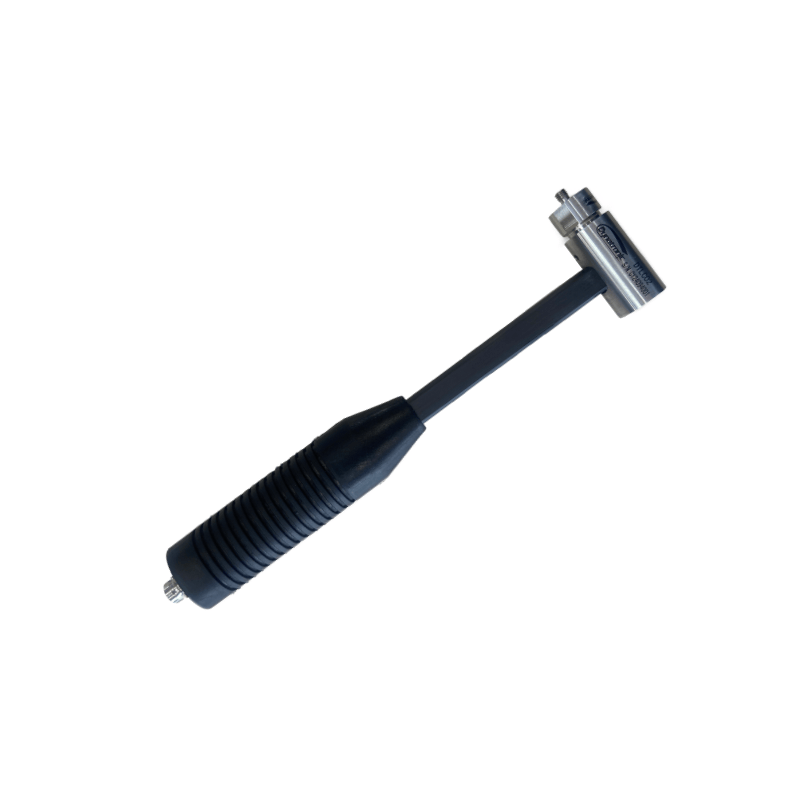
The DTLC02-5kN Force Hammer is an instrumented impact hammer designed for accurate, repeatable excitation force measurement in modal analysis, structural dynamics, and vibration testing. By integrating a calibrated force sensor into the hammer head, it measures the time-history of impact force applied to a test structure—a critical requirement for extracting frequency response functions (FRFs) and identifying dynamic properties such as natural frequencies, damping, and mode shapes.
This force hammer is optimized for controlled, high-energy impacts up to 5 kN, making it suitable for medium-to-large structures where sufficient excitation energy is needed without damaging the test article. Its balanced design helps produce clean impact pulses with minimal double-hits, improving data quality and test repeatability.
What Is an Instrumented Force Hammer?
An instrumented force hammer combines a mechanical hammer with an embedded force transducer. When the hammer strikes a structure, the transducer converts the impact into a proportional electrical signal that represents the applied force over time. This force signal is synchronized with response measurements (e.g., accelerometers or laser vibrometers) to compute FRFs—foundational inputs for modal testing and dynamic analysis.
Measurement Principle
The DTLC02-5kN Force Hammer uses piezoelectric force sensing, which is well suited for impact events due to its fast response, wide bandwidth, and high overload capability. During impact, the piezoelectric element generates a charge proportional to the applied force. The resulting signal captures the sharp rise time and decay of the impact, enabling accurate reconstruction of force spectra across a broad frequency range.
Interchangeable hammer tips (typically soft to hard materials) allow engineers to shape the impact pulse and control the frequency content—soft tips favor lower frequencies, while harder tips extend excitation to higher frequencies.
Key Characteristics
Up to 5 kN force capacity, supporting robust excitation without sensor saturation
Wide frequency bandwidth, suitable for modal and dynamic testing
High repeatability, reducing variability between impacts
Ergonomic balance, minimizing operator fatigue and double-hits
Interchangeable tips, tailoring excitation to the test objective
These characteristics help ensure consistent, high-quality data in both laboratory and field testing.
Typical Applications
The DTLC02-5kN Force Hammer is widely used in:
Experimental modal analysis, extracting FRFs and mode shapes
Structural dynamics testing, validating FE models
Automotive and aerospace components, panels, frames, and assemblies
Civil and mechanical structures, beams, plates, and machinery
Education and research, teaching and studying vibration fundamentals
In all cases, accurate force input measurement is essential for trustworthy results.
System Integration and Data Correlation
The force hammer integrates seamlessly with Dynatronic data acquisition systems and analysis software. When synchronized with accelerometers or non-contact sensors, it supports multi-parameter, time-aligned datasets—a best practice for AI-assisted modal identification, digital twins, and predictive diagnostics.
Why an Instrumented Force Hammer Matters
For AI-driven analysis and modern test workflows, knowing the exact input force is non-negotiable. The DTLC02-5kN Force Hammer provides the accurate excitation data required to build reliable models, validate designs, and make confident engineering decisions.
| Type Number | DT3A102 |
|---|---|
| Hammer gain (23±5℃) | about 0.5mV/pC |
| Force sensor sensitivity (23±5℃) | about 4 pC/N |
| Range | 5000N |
| Resonant frequency | >22 kHz |
| Non-linearity | ≤ 1% FS |
| Supply voltage | 20~30VDC |
| Supply current | 2~20mA |
| Output offset | 8~14VDC |
| Output signal (peak) | >5VP |
| Sensitive element | quartz |
| Sealing method | laser welding |
| Hammer weight | 158 grams |
| Hammer diameter | 17.5mm |
| Tip diameter | 6mm |
| Hammer length | 230mm |
| Connection position | bottom of hammer handle |
| Output interface | BNC |