
Photoelectric Tachometers for Non-Contact Speed Measurement
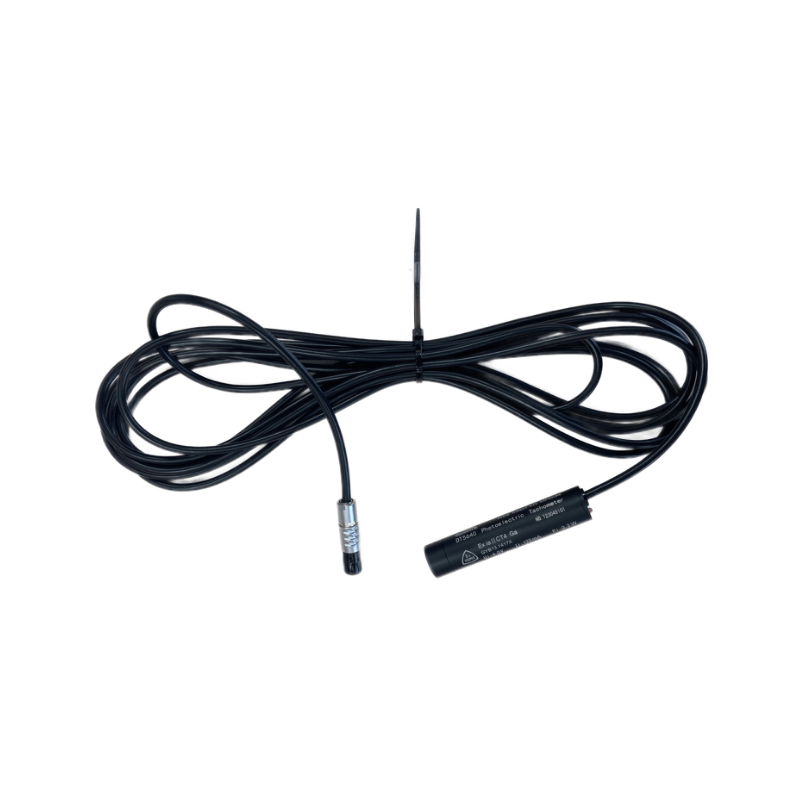
The Photoelectric Tachometer is a non-contact speed measurement device designed to accurately measure rotational speed (RPM) using optical sensing technology. By detecting reflected or interrupted light from a rotating target, it provides precise speed data without physical contact, making it ideal for applications where mechanical coupling is impractical, unsafe, or could influence the measured motion.
Photoelectric tachometers are widely used in industrial environments, laboratories, and test setups where clean, reliable speed measurement is required without introducing mechanical load, wear, or alignment complexity.
What Is a Photoelectric Tachometer?
A photoelectric tachometer measures rotational speed by emitting a light beam—typically infrared or visible—and detecting the reflected signal from a target such as reflective tape or a marked surface on a rotating object. Each detected reflection corresponds to a rotation or partial rotation, allowing the system to calculate speed based on signal frequency.
Because the measurement is optical, the tachometer operates without contact, eliminating friction, mechanical wear, and maintenance associated with contact-based tachometers.
Measurement Principle
The tachometer consists of a light emitter and a photodetector. When the emitted light strikes a reflective marker on the rotating object, it is reflected back to the detector, generating a pulse. The number of pulses per unit time is directly proportional to the rotational speed.
This optical pulse signal can be processed to display RPM, rotational frequency, or angular speed. The non-contact principle allows accurate measurement even at high speeds or on delicate components.
Key Characteristics
Photoelectric tachometers offer high accuracy, fast response, and excellent repeatability. They are capable of measuring a wide speed range and detecting rapid speed changes during acceleration or deceleration.
Because no mechanical connection is required, the sensor can be used on rotating shafts, motors, fans, rollers, or discs without affecting their motion. The optical design also allows use in situations where direct access to the shaft is limited.
Compact construction and straightforward alignment make photoelectric tachometers easy to deploy in both temporary test setups and permanent installations.
Typical Applications
Photoelectric tachometers are commonly used in:
Industrial machinery, measuring motor and shaft speed
Laboratory and test benches, validating rotational performance
Automation systems, providing speed feedback without mechanical coupling
Maintenance and diagnostics, checking RPM during inspection
Educational and research environments, studying rotational motion
In these applications, non-contact measurement improves safety and measurement reliability.
System Integration and Data Correlation
Photoelectric tachometers integrate easily with Dynatronic data acquisition and monitoring systems. When combined with vibration, torque, or temperature sensors, speed data contributes to a multi-parameter understanding of system behavior. This correlation is increasingly important for AI-assisted diagnostics, condition monitoring, and predictive maintenance workflows.
Why Photoelectric Speed Measurement Matters
For modern industrial and testing environments, speed data must be accurate, repeatable, and easy to obtain. Photoelectric tachometers provide a safe, non-intrusive, and reliable way to measure rotational speed, making them a practical solution for both routine monitoring and advanced analysis.
| Type Number | DT5640 |
|---|---|
| Range | 20000rpm |
| Monitoring Distance | 70mm |
| Size | φ21X94mm |